
Bear watching is exhilarating and rewarding. Bears are one of the most endearing of large carnivores and undoubtedly one of the most photogenic. Our bear watching holidays offer a wide range of trips, destinations and locations that we’ve spent years developing, including...


Why our bear watching holidays are so successful


What bears to see and where
Primarily northern hemisphere animals, bears are largely found in Asia, Europe and North America. With the exception of the polar bear, most bears are forest species, but may seasonally inhabit alpine scrub or tundra areas.
Our trips range from short breaks to see European brown bears to longer trips in search of grizzly and spirit bears in Canada, polar bears in Arctic regions, American black bears in British Columbia, or sloth bears in India.
American brown (grizzly) bear

One of the highest concentrations of brown bears in Canada can be found at Bella Coola, a hidden gem in a vast area known as the Great Bear Rainforest. Alaska is also famed for its grizzlies, particularly in the volcanic Katmai National Park during the salmon run, and on Kodiak Island which has been inhabited by brown bears for over 12,000 years.
For grizzly bear watching trips, we have several options in Canada such as The Bear Essentials trip idea where you can spend seven days enjoying daily bear watching trips, a self-drive option in Vancouver Island, a photography tour in search of coastal wolves & grizzly bears and Safari Slowly on Canada's West Coast. In Alaska, our Seldom Seen Photography Tour uses private catamaran boat trips during the day, with stays in comfortable lodges in the evenings.
We also offer wildlife voyages in Canada and Alaska, including Grizzlies of Khutzeymateen and Great Bear Rainforest in Canada, and Bears & Whales in South-east Alaska or Alaska’s Inside Passage: Bears & Whales Safari.
European brown bear
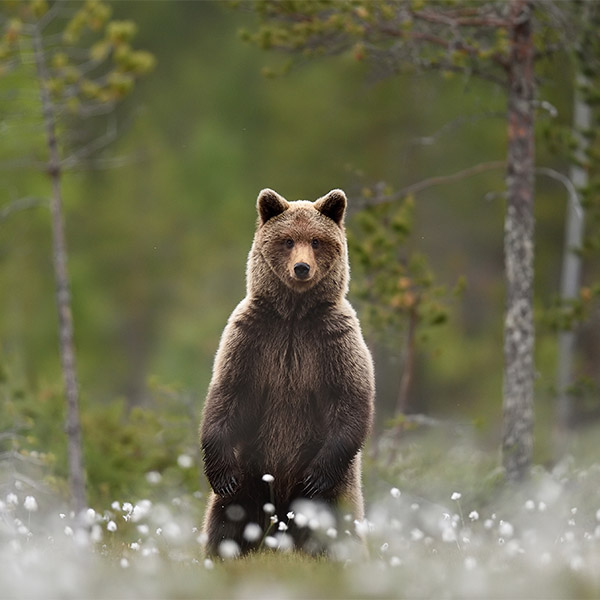
Europe offers a variety of locations to view brown bears in the wild, ranging from the dense forests of Finland, to mountainous regions of Romania, and the protected area of La Montaña Palentina in northern Spain.
We feature several bear watching trips in Europe. In Slovenia, combine bear watching with a few days at Lake Bled, whilst Finland offers several choices including our popular Brown Bear Explorer group tour, a tailor-made self-drive option, a photography tour in spring or autumn, or our 'In Style' trip idea, where you can watch brown bears from your own luxury cabin. Our Romania trips include a Wildlife Highlights tour which also visits the Danube Delta, or our Birds & Bears in Transylvania trip, focused in the Carpathian Mountains.
Spirit bear

Searching for these rare creatures on our spirit bear trips is an adventure in itself, and involves boat trips and short walks to reach specially located viewing platforms which offer superb photographic opportunities. The platforms are well positioned above salmon streams and patience is likely to be rewarded not only with spirit bears but black bears fishing for salmon. If you want to see spirit bears, we recommend our wildlife cruise to Great Bear Rainforest.
American black bear

Bear watching is highly seasonal and dependent on some of nature’s other wonders, particularly the running of salmon in the rivers and streams. Essentially, the northern hemisphere summer months are best for black bear watching, with many bears being visible in the latter part of the season due to an essential need to gorge themselves before hibernating.
In addition to our wildlife cruise to Great Bear Rainforest, black bears may also be seen in Canada on our Vancouver Island Self-drive tour and Haida Gwaii Cruise in British Columbia, Canada's Big Five in Manitoba, and Newfoundland Adventure on Canada's East Coast, plus our Seldom Seen Photography Tour in Alaska.
Polar bear

Churchill in Canada is known as the ‘polar bear capital of the world’ and is the only human settlement where polar bears can be observed in the wild – it lies right in the bears’ migratory path. They gather in Churchill, on the west coast of Hudson Bay, during October and pass through the area until November. Our polar bear watching trips in Canada include Classic Polar Bears where you embark on excursions from a specially-designed Polar Rover and Canada's Big Five, a tailor-made holiday that also spends time searching for black bear!
Sloth bear

Satpura National Park in India is a particularly good area to see sloth bear in India, and our Walking with Sloth Bears itinerary gives the rare opportunity of experiencing a safari on foot, as well as by vehicle.
In Sri Lanka, previous trips to Kumana and Wilpattu National Park have enjoyed encounters with sloth bears. Choose from our Sri Lanka's Rare Mammals in Style or our Leopard & Sloth Bear Photo Safari.