Travel, experience, conserve with
Wildlife Worldwide
Phone:
Jump to main menu

Penguin watching can be immense fun as these endearing and frequently comical flightless birds are full of character. Our penguin watching holidays offer a wide range of trips, destinations and locations chosen to give the very best penguin experiences, such as…

View all penguin watching trips

Why our penguin watching holidays are so successful

We carefully select locations with an excellent record of sightings
We work with expert naturalist guides with local knowledge and experience
The expedition vessels we use offer various levels of comfort
There are always great opportunities to see other wildlife in the area

Where to see penguins & which species to see

Penguins are mostly found in the Southern Hemisphere and throughout the southern oceans, except for the Galápagos penguin, which is the only species found north of the equator. You can see: Magellanic penguins along the coasts of Argentina and Chile. head to the Falkland Islands to see gentoo, rockhopper, macaroni and king penguins.

On South Georgia, you’ll encounter large colonies of chinstrap penguins and even more king penguins. If you're embarking on an Antarctic expedition voyage, you’ll have the chance to see many of these species, as well as Adélie penguins.

Alternatively, you can see penguins galore on any expedition voyage that visits the Antarctic, and some trips to the Galápagos where you can see penguins of the same name. To see emperor penguins, however, you need to visit Snow Hill Island in the Weddell Sea – the only place where they can be seen. 

For those heading further afield to the Subantarctic islands, you can catch a glimpse of the striking royal penguins on Macquarie Island, rare Snares penguins on New Zealand’s Snares Islands, or erect-crested penguins on the Bounty and Antipodes Islands.

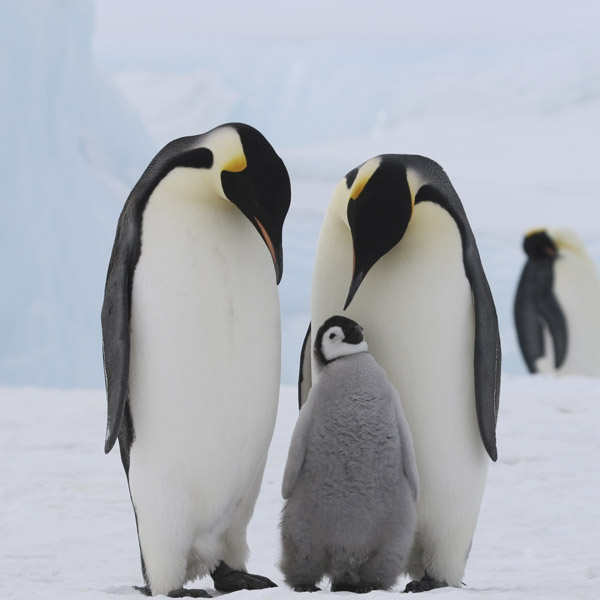
Emperor penguin

The emperor penguin (Aptenodytes forsteri), the largest and heaviest penguin, is endemic to Antarctica, exclusively between latitudes of 66° and 77° South. Adult plumage is mostly black, with white underwings and belly turning into pale yellow in the upper breast, and with bright yellow ear patches. The upper mandible of the long bill is black, while the lower one can be pink, orange or lilac, making a highly distinctive – and impressive – appearance.

Our Emperor Penguins of the Weddell Sea itinerary, provides the perfect opportunity to visit these remarkable penguins in one of the most remote regions of Antarctica. Time is dedicated to visiting an emperor penguin colony, located south of Snow Hill Island, accessible only by helicopter.

Macaroni penguin

The macaroni penguin (Eudyptes chrysolophus) is found from the sub-Antarctic to the Antarctic Peninsula. As one of six species of crested penguin, it is closely related to the royal penguin – indeed some authorities consider the two to be a single species. It has a distinctive yellow crest and red eyes, and its black face and upperparts are sharply delineated from the white underparts. The Falklands are an excellent place to view these penguins, with colonies being found on Pebble Island and Saunders Island.

Observe the flamboyant macaroni penguins with their vibrant yellow crests on our Highlights of the Falkland Islands. This unique tailor-made itinerary hops between various wildlife hotspots and includes opportunities to discover up to five species of penguin, plus elephant seals and a host of bird species.

Gentoo penguin

The long-tailed gentoo (Pygoscelis papua), the third largest species, belongs to the same genus as Adélie and chinstrap penguins. First described in 1781 on the Falkland Islands, it identified by the broad white stripe that runs across the top of its head, and by its bright orange-red bill. It has pale-coloured webbed feet and a prominent tail that sweeps from side to side as it waddles on land. The most common of its various calls is a loud trumpeting when it throws its head back.

Although adapted to harsh cold climates, its breeding colonies are always on ice-free surfaces along or close to the shoreline, with nests often sited between tufts of grass. They breed on many sub-Antarctic islands and in the Antarctic Peninsula.

Spot the curious and energetic gentoo penguin on our Classic Antarctica voyage. The perfect introduction to Antarctica, this expedition visits prime wildlife sites along the peninsula and nearby South Shetland Islands.

Adélie penguin
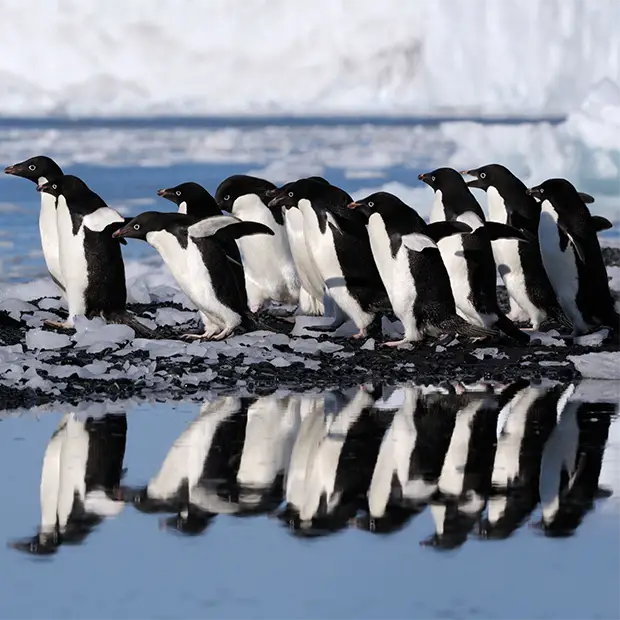
Adelie penguin in Antarctica
The Adélie penguin (Pygoscelis adeliae) is a captivating species found in the Antarctic region. Recognised by its sleek black back, white belly, and striking orange-red beak, it navigates icy waters with its pink webbed feet. These social birds form large colonies for breeding and hunting krill and fish. Adélie penguins exhibit remarkable navigational skills, travelling long distances for food. They construct nests with rocks to protect their eggs and chicks. Adapted to extreme cold, they represent resilience and adaptability, thriving in one of Earth's harshest environments, while captivating travellers with their distinctive appearance and behaviour.

Enjoy close encounters with Adélie penguins as they waddle across the ice and dive gracefully into the Southern Ocean on our Crossing the Polar Circle voyage. This extraordinary voyage offers the opportunity to cross the Antarctica Circle and venture beyond it, discovering a rarely seen, isolated world. 

Royal penguin

Royal penguin in Macquarie Island
The royal penguin (Eudyptes schlegeli) exhibits a striking appearance with its vibrant orange beak and white face that contrasts sharply with its black back and wings. It's distinguished by its yellow-orange crest extending from its forehead to the back of its head. Found primarily on Macquarie Island and nearby islets, this species is known for its distinctive calls, which help individuals locate their mates and chicks within the colony.

Venture to remote Macquarie Island onboard our Birding Expedition Down Under and encounter the striking royal penguins with their bold crests. The ultimate expedition for penguin and pelagic enthusiasts, and those interested in island endemics, this voyage explores the Chatham and Subantarctic Islands.

Snares penguin

Snares penguin in Snares Island
The Snares penguin (Eudyptes robustus), endemic to the Snares Islands off the southern coast of New Zealand, features a distinctive appearance with a dark grey-blue back, white underside, and a small white crescent-shaped patch above each eye. Its bill is black and relatively short compared to other crested penguin species. Snares penguins are known for their shy and elusive nature, often retreating to rocky coastal areas or dense vegetation for nesting. With a diet primarily consisting of fish and squid, they're skilled hunters, using their streamlined bodies to navigate underwater.

You can visit the secluded Snares Islands and marvel at the unique Snares penguin, found nowhere else on Earth, aboard our once-in-a-lifetime Ross Sea Expedition. With many wildlife highlights, including whale and penguin watching, this epic voyage travels to the remote Ross Sea region of Antarctica. 

Rockhopper penguin

The rockhopper (Eudyptes chrysocome) consists of three closely related subspecies of crested penguin that are sometimes treated as a single species. With a global population of around one million pairs i.e. two-thirds of the total population, the southern rockhopper breeds in the Falklands and on islands around the tip of Argentina and Chile.

The related eastern rockhopper breeds on the sub-Antarctic islands of the Indian and western Pacific oceans. Outside the breeding season, rockhoppers can be found roaming the waters off their colonies, feeding on krill, squid, plankton, cuttlefish and crustaceans.

For a delightful encounter with this energetic species, sail aboard our Great Antarctic Voyage visiting the Falklands, South Georgia, and Antarctica. This ultimate expedition includes visits to huge penguin colonies, dramatic wilderness areas and hauntingly beautiful polar scenery. 

Magellanic penguin

The Magellanic penguin (Spheniscus magellanicus) was named after Portuguese explorer Ferdinand Magellan, who first sighted it in 1520, and is native to South America. These medium-sized birds breed along the coastline of Argentina, Chile and the Falkland Islands, although some migrate to Brazil and are occasionally seen as far north as Rio de Janeiro.

The world’s largest breeding colony of Magellanic penguin is found at Punta Tombo in Argentina, where you can walk amongst them and closely observe them building nests, feeding chicks and in courtship and territorial disputes.

Set sail on our Ultimate Antarctica voyage to witness the lively Magellanic penguins as they nest along the rugged shores of the Falklands. This impressive journey encompasses the wild Falkland Islands and pristine wilderness of Antarctica, venturing beyond the Antarctica Circle for the ultimate adventure of a lifetime. 

King penguin

The king penguin (Aptenodytes patagonicus), the second largest species of all, breeds on sub-Antarctic islands between 45° and 55°S, at the northern reaches of Antarctica, as well as Tierra del Fuego, the Falkland Islands, and other temperate islands of the region. Where conditions are suitable, such as at Salisbury Plain on South Georgia Island, they can form huge colonies of over 100,000 breeding pairs, which – because of the long breeding cycle – are continuously occupied.

Join an unforgettable expedition to the sub-Antarctic and stand among the regal king penguins, second only to the emperor in size, on board our South Georgia & Falklands Wildlife Extravaganza. This voyage offers a profusion of wildlife including vast numbers of penguins, fur and elephant seals and masses of seabirds. 

Chinstrap penguin
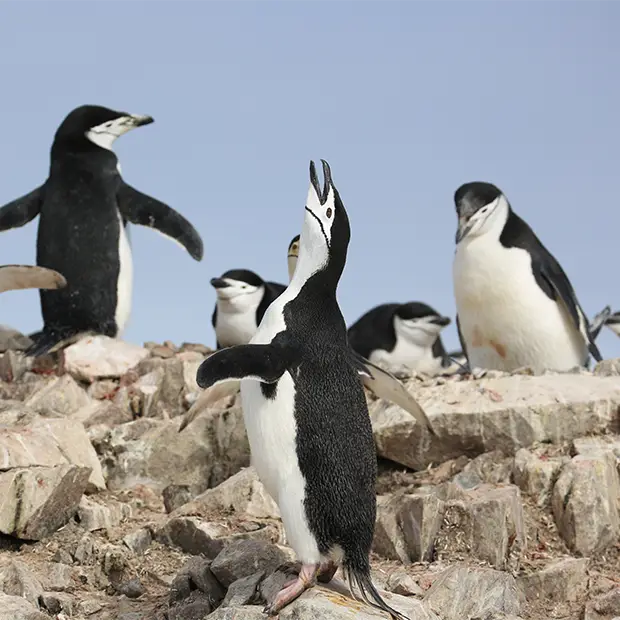
Chinstrap penguin in Antarctica
The chinstrap penguin (Pygoscelis antarcticus) is easily identifiable by the narrow black band under its chin, which gives it its name. Sporting a sleek black-and-white appearance, its feathers are predominantly black on the back and head, with a white underside. This species boasts a pointed beak and pink feet. Chinstrap penguins are known for their agility in the water and can dive to considerable depths in search of food. Interestingly, despite their adorable appearance, they can be quite feisty, particularly during mating season when they engage in vigorous courtship rituals.

Meet the lively chinstrap penguins on our Antarctica Penguin Safari. Their bold personalities and striking markings make for a fascinating encounter! This one-of-a-kind safari includes the wild wonders of South Georgia and Antarctica, with opportunities to witness up to five penguin species amidst incredible landscapes.

Erect-crested penguin

Erect-crested penguin in New Zealand
The erect-crested penguin (Eudyptes sclateri) is aptly named after the vertical yellow crest atop its head, which sets it apart from other penguin species. With a predominantly black body and white underside, these penguins have vibrant orange bills and feet. They inhabit the Antipodes Islands and occasionally other nearby locations. Despite their striking appearance, erect-crested penguins are considered one of the rarest penguin species, with only a few thousand individuals remaining. 

If you’re looking for a unique wildlife expedition, particularly to the southern Subantarctic Islands, our Birding Expedition Down Under provides an excellent opportunity to encounter this rare species. Breeding almost exclusively on the Bounty and Antipodes Islands, located south of New Zealand, this exceptional expedition offers a once-in-a-lifetime adventure to witness this elusive species.  

Galapagos penguin
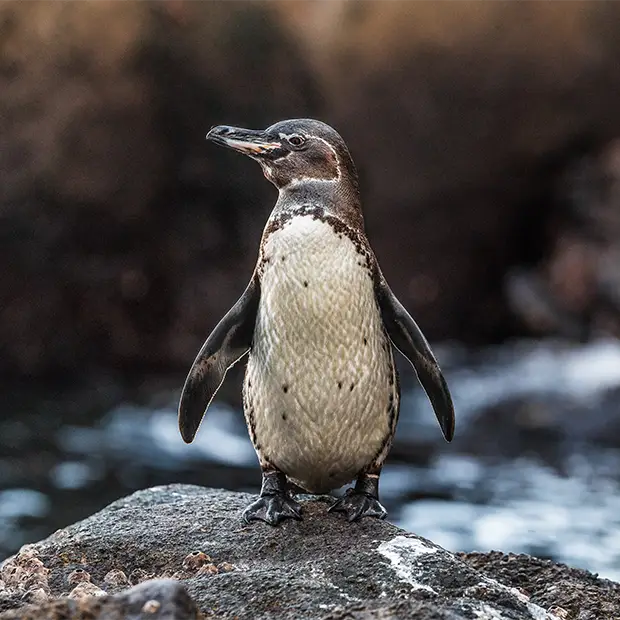
Galapagos penguin in the Galapagos Islands
The Galapagos penguin (Spheniscus mendiculus) is the only penguin species found north of the equator, inhabiting the Galapagos Islands. This species is notable for its small size and adaptation to warmer climates. It has a black head and back, with a white underside, and features a narrow white line around its face. Galapagos penguins have pinkish feet and a distinctive black stripe across their chest. They face unique challenges due to their limited habitat and vulnerability to El Niño events, which can disrupt their food sources and breeding cycles. Despite these challenges, conservation efforts have helped stabilise their populations in recent years.

Explore the wonders of the Galapagos and encounter this playful species, the only one found north of the equator, on our Western Galapagos Highlights expedition. This small ship adventure offers a fantastic holiday for wildlife explorers and nature enthusiasts. 
View all penguin watching trips