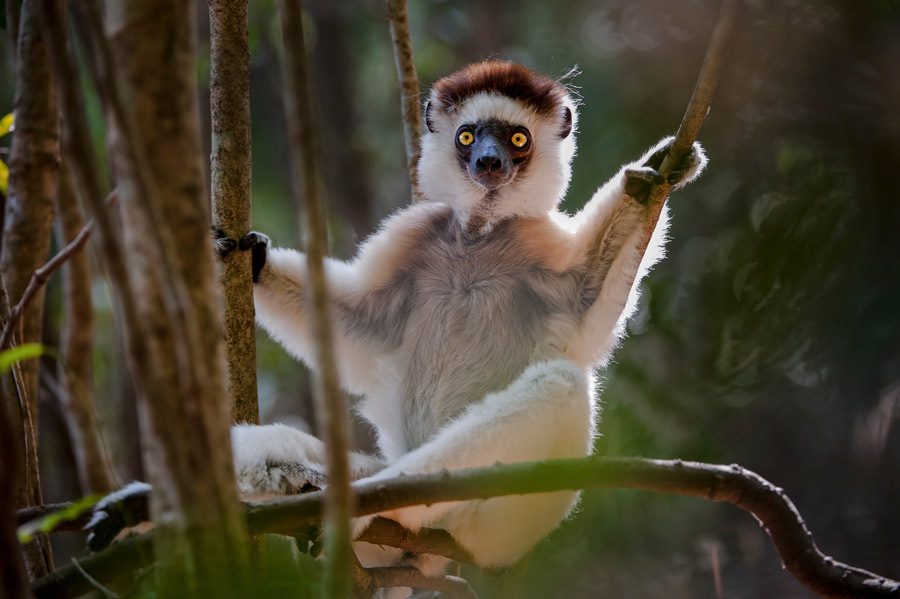
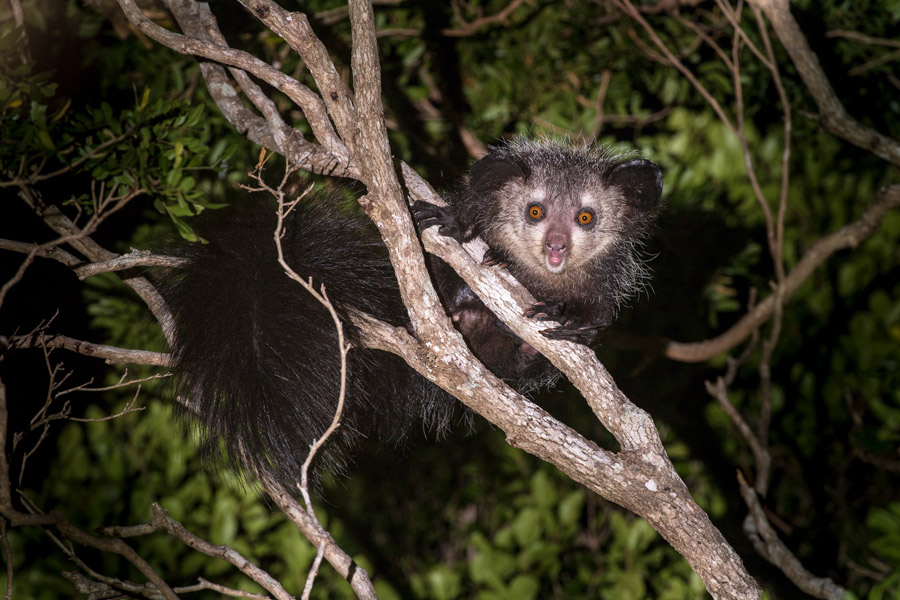
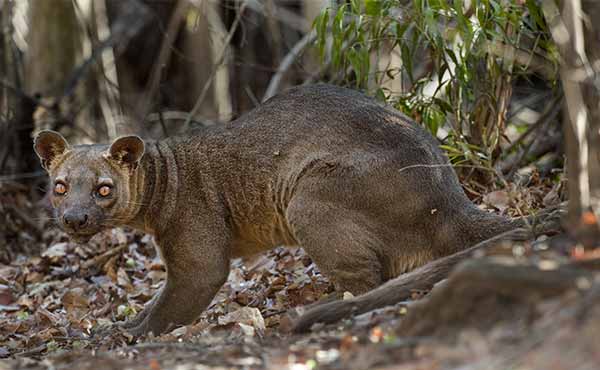
Discovering the rare mammals found in both the dry forests of the west and the lush rainforests of the east we take in some of Madagascar’s most magnificent species. We hope to encounter mammals such as fosa, aye-aye, indri, Verreaux’s sifaka and the Madame Berthe’s mouse lemur.
Visiting two contrasting ecosystems, this gentle paced small group tour, led by experienced tour leader Kenny Andriamaronjaka, seeks outs some of Madagascar’s most extraordinary mammals. During our time in Madagascar, we are likely to encounter most of the key lemur families, from the tiny mouse lemurs to curious sportive lemurs and acrobatic sifakas to the impressive tail-less indri. We also aim to find some of its other most unique mammals, including two members of the distinct Malagasy carnivores, the fosa and narrow-striped boky-boky, as well as other unusual species like the giant jumping rat and tenrecs. We also look for the most bizarre of all Madagascar’s mammals, the incomparable aye-aye.
Starting in the west with the dry deciduous forests of the Kirindy Reserve, we go in search of a unique set of mammals, some of which are only found in this threatened habitat. This is the best location in Madagascar to see the fosa, the country’s largest and most charismatic carnivore, as well as some other rare mammals such as the giant jumping rat and the narrow-striped boky. Lemurs are also well represented, and we will hopefully be treated to the athletic leaps of the Verreaux’s sifaka. While at night we focus on finding the tiny Madame Berthe’s mouse lemur, the smallest primate in the world in addition to six other species of nocturnal lemur.
Moving to the east, we then explore the lush rainforests of Andasibe and in particular the lemur rich Maromizaha and Mitsinjo reserves. Here we can enjoy thrilling encounters with the largest lemur, the indri, plus the beautiful diademed sifaka and seek the rare red-bellied, grey bamboo and black-and-white ruffed lemurs among others. We will again also explore the forest reserves after dark, searching for a range of nocturnal lemurs, tenrecs, reptiles and frogs found in this habitat too. In Maromizaha we hope for an encounter (if we are lucky) with the strangest of all lemurs, the enigmatic and elusive aye-aye. Our final destination is the Palmarium Reserve on the eastern coast near the Pangalanes Canal where we can enjoy close views of the wonderful aye-aye in addition to a great diversity of other lemurs, rainforest reptiles, frogs, insects and birds.
Typical Itinerary
-
Day 1:
Depart UK
Fly from London Heathrow on an overnight flight to Nairobi.
-
Day 2:
Arrive Antananarivo
Arrive in Nairobi and take a shuttle to the airport hotel for day use of a room. Later we take an onward flight to Antananarivo. On arrival, we transfer to our nearby hotel.
Accommodation: Le Relais des Plateaux, 1-night
-
Day 3:
Transfer to Kirindy Reserve
This morning, we return to the airport and fly from Antananarivo to Morondava Airport.
We are met on arrival in Morondava and transfer around two hours to our accommodation close to the Kirindy Forest.
After we have had a chance to settle in, we visit the Kirindy Reserve for our first afternoon and night walk in search of the unique mammals and other wildlife found in this habitat.
Accommodation: Le Relais du Kirindy, 3-nights
-
Days 4-5
:
Explore Kirindy Reserve
Over the next three days, we discover the wildlife of the Kirindy Reserve through its network of flat and easy trails. During the day we can enjoy close encounters with both the silky furred Verreaux’s sifaka and the inquisitive red-fronted brown lemur and spot the locally endemic red-tailed sportive lemur in its day roost. Another highlight of Kirindy is that it is home to the charismatic fosa, the island’s top predator, and the smaller mostly insectivorous narrow-striped boky-boky, both of which can often be found close to the main lodge.
We also explore at night in search of nocturnal mammals that include the wonderfully bizarre giant jumping rat and nocturnal lemurs such as the pale fork-marked and fat-tailed dwarf lemur. Another speciality of this dry deciduous forest we hope to see is the tiniest of all the lemurs and all the world’s primates, the diminutive Madame Berthe’s mouse lemur.
-
Day 6:
Kirindy Reserve & Morondava
Today we have a final morning to explore the Kirindy Reserve in search of its special species before we return to Morondava for the night. We pass the iconic Avenue of Baobabs on the way and can enjoy some time to rest at our seaside hotel in the evening.
Accommodation: Palissandre Cote Ouest Resort, 1-night
-
Day 7:
Transfer to Antananarivo
Today we have the morning at leisure before returning to the Morondava airport where we take our flight back to Antananarivo. On arrival at the airport in Antananarivo, we transfer to our hotel for the night.
Accommodation: Le Relais des Plateaux, 1-night
-
Days 8-11
:
Explore Andasibe-Mantadia National Park & Maromizaha Reserve
Today we set off for the drive (approximately five hours in total) to Andasibe arriving in time for lunch.
In the afternoon we visit the nearby Maromizaha Reserve, home to Madagascar’s largest species of lemur, the spectacular indri, as well as the beautiful diademed sifaka. We continue to explore dark to look for the nocturnal lemurs, Goodman’s mouse lemur, Eastern woolly lemur, Crossley’s dwarf lemur and if we are lucky even the mysterious aye-aye.
Over the course of the next three days, we explore the reserves of Maromizaha and Analamazaotra (Andasibe) on walks during the day and later into the evening to observe both the diurnal and nocturnal lemurs and other wildlife found in this diverse montane rainforest region.
Maromizaha is a quieter and less well visited reserve that protects an excellent example of higher altitude rainforest. The trails here are easier going than in the more remote Mantadia National Park, and there are many habituated family groups of lemurs. The wonderful tail-less indri will undoubtedly be a highlight here, and we may be treated to up close views of these stunning and agile lemurs, even leaping over our heads. We will also search for the highly endangered black-and-white ruffed lemur that favours the areas of older growth forest, along with the beautiful, red-bellied lemur and diademed sifaka. While the thickets of bamboo in Analamazaotra will hopefully reveal the eastern grey bamboo lemur and curious groups of common brown lemur. On our night walks in Maromizaha we will likely encounter the tiny fast moving Goodman’s mouse lemur, the Crossley’s dwarf lemur and large eyed eastern woolly lemurs. Maromizaha is also home to a population of aye-aye which sometimes visit fruiting trees at this time of year, so we may be lucky to spot one during our nocturnal forays.
Accommodation: Mantadia Lodge, 4 nights
-
Day 12:
Explore Mitsinjo Reserve & Palmarium Reserve
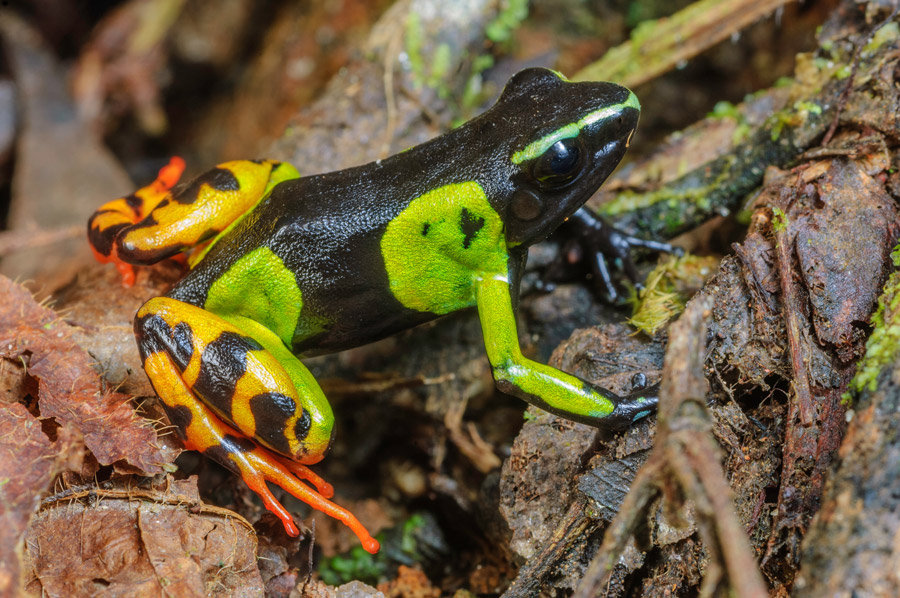
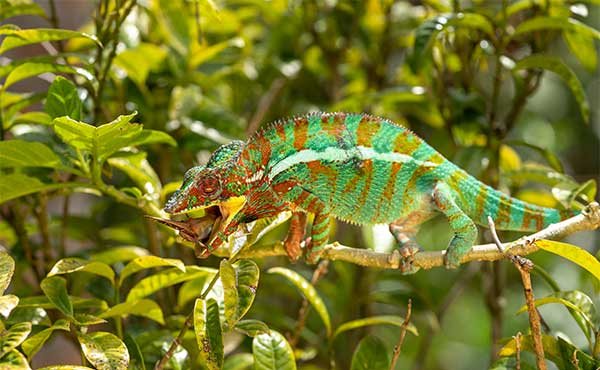
This morning we visit the community run Mitsinjo Forest Reserve, another area of protected secondary forest, that offers sensational indri sightings and a chance to find tenrecs, particularly the striking lowland-streaked tenrec. After learning about the community involvement and important wildlife research of the reserve, we may also find some of its special reptiles and frogs, such as the huge Parson’s chameleon and colourful painted mantella. Later we set off for the drive to Palmarium Reserve at Akanin'ny Nofy.
This evening we make a visit to a small, forested island for unforgettable close encounters with the extraordinary aye-aye.
Accommodation: Palmarium Lodge, 2-nights
-
Day 13:
Explore Palmarium Reserve
Today we have a full day to enjoy the abundant lemurs, reptiles, and frogs of the Palmarium Reserve.
Palmarium is home to many lemurs including semi-wild populations of the dark morph of indri, common brown lemurs, and a small population of bamboo lemurs. There are also introduced populations of other lemurs, all of which can provide remarkably close views and great photographic opportunities. Reptiles are also diverse and include some strikingly colourful day geckos, camouflaged leaf-tailed geckos, various chameleons and even the rare leaf-nosed snake. Later we enjoy a second evening of aye-aye watching on the nearby island.
-
Day 14:
Return to Antananarivo & fly to UK
Today we make the journey back to Antananarivo, starting with a relaxing boat trip along the Pangalanes Canal back to Manambato. We then drive back to Antananarivo, stopping for lunch in the Andasibe area and at times to stretch our legs and see more of rural Madagascar. We arrive back at our hotel in Antananarivo in the late afternoon, where we have day use of a room and the facilities at Le Relais des Plateaux. Later it will be time to return to the airport for our flight home.
-
Day 15:
Arrive UK