Incredible Whale Watching on a Glassy Salish Sea
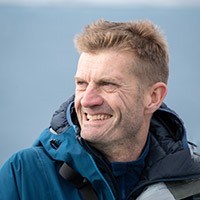
Wildlife Worldwide founder Chris Breen shares his experience exploring the coastal waterways of the Salish Sea, British Colombia. It's safe to say the abundance of wildlife sightings did not disappoint!
It's difficult to describe today's whale watching without a continuous stream of superlatives – it was nothing short of incredible.
The sky was clear and the sea calm, the weather forecast was for 16°C, so we were keen with anticipation as we went to the jetty for our 9.30am liaison with Oryan and Adrian, our whale watching guides. Some of the group did a ‘switcheroo’ from the boat they were in yesterday, and before too long we were all set to get out on the water. Killer whales had been seen off the coast of Victoria so we travelled parallel to the peninsular towards Discovery Island and headed south.
 At Zero Rock – a fairly sizeable chunk in the middle of one of the channels that would have caught an earlier era of seafarers off guard (and not doubt has) – we stopped to look at a large raft of surf scoters. And then as we rounded the southern top of Vancouver Island we headed for a little group of islands called Chain Islands where there were hauled out harbour seals as well as cormorants, common murres (guillemots) and a few brightly coloured harlequin ducks.
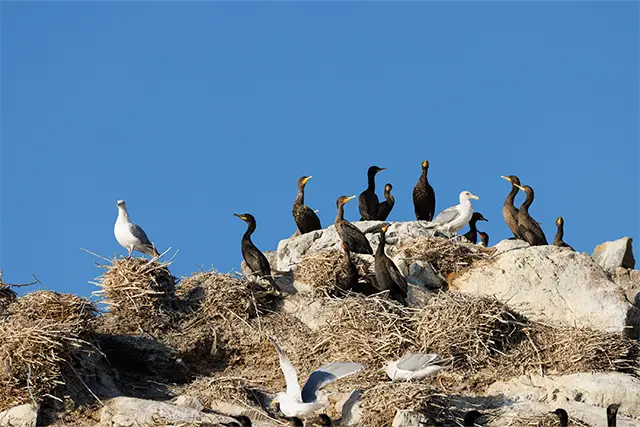 As we continued on our track it was clear that for those interested in seabirds there was plenty to see with rafts and rafts of hundreds (if not thousands) of common murres – these were visible throughout the day. Interspersed with the murres were a few rhino auklets and occasionally small flocks of phalaropes (though the species was indistinguishable).
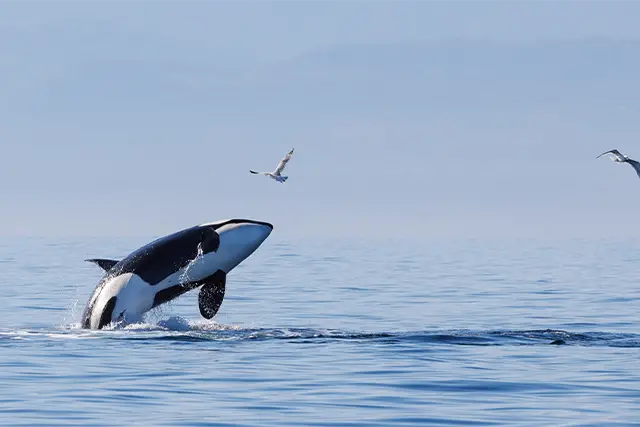
But these were simply distractions for the main event, and when Adrian and Oryan heard that there were no fewer than nine orcas that had been seen, we made a beeline for them. On the northern side of the Juan de Fuca Strait, was a group that consisted of two pods – T60 and T99, and we were with them for some time. They had clearly killed a seal or sea lion recently and were breaching, tail-breaching, rolling and playing.
All of the killer whales we have been seeing are Bigg’s (transient) killer whales, which for the time being have really become semi-resident in the area. They're mammal-eating killer whales that hunt seals and sea lions as their regular prey.
Having spent a considerable period of time with them, we carried on west for another few kilometres where we paused to watch five humpbacks – it appeared to be two separate pairs feeding in close proximity and another single whale feeding nearby too. Unlike the humpbacks we saw yesterday, these whales appeared to be feeding fairly closed to the surface and there was very little fluking and deep diving. As Chris was passing round a snack to everyone in the Zodiac (it's hungry work looking at so many whales!) there was an in-drawing of breath as a humpback breached right next to the boat.
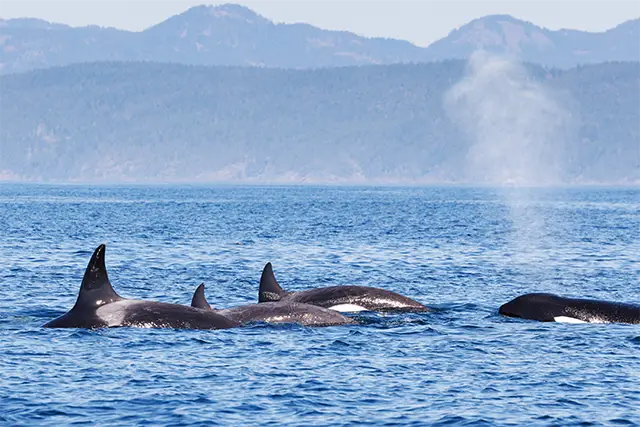 From here we headed south-west and into US waters as we heard that there was a group of five killer whales that had been seen there, but on the way we found a single adult female killer whale right in the centre of the strait. Whilst it's fairly normal to see adult males alone, it's unusual to see adult females alone, especially so far away from the rest of the pod. We waited with the female as a nearby research boat wanted to photograph and identify her.
As we were watching the group of five we could see another group of killer whales which we were told was the T18 group which consisted of two pods – one of six and another of four. But, we could also see another group of four nearby too, it was impossible to know where to look – we even heard one of the researchers over the radio saying “it really doesn’t get any better than this”. The researchers follow the killer whales every single day so it really must have been exceptional!
Precisely what was happening in the area we'll never know, but there were clearly a number of orcas groups that were meeting and possibly hunting together. This is also likely to be a time when adult males would have left their family group and mated with females from another pod before returning to their own family group. One of the males that we saw was a huge, and easily identifiable whale called Galliano. He has a large, and very ‘broad’ dorsal fin with a distinctive ‘nick’ at the back. He's known to be in his late 20s.
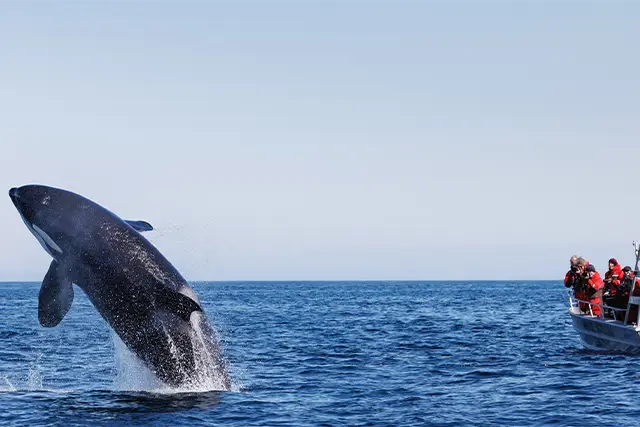 There were a few other whale-watching boats in the area, but it didn’t distract from our viewing in any way – especially as there were just so many whales to see. We must have been with the whales here for well over an hour, but the time just melted away.
From here we headed north, to the southern shoreline of Vancouver Island and paused at Alldridge Point to see a small petroglyph that's known to have been made by early First Nations’ settlers and could be as old as 1,000 years. Whilst we were at the petroglyph (which isn’t the easiest to see as it is now very faint) we also had a pair of black oystercatchers and a single black turnstone.
It was getting late in the afternoon now, and we began to head for home, but not before looking in and around Little Church Island and Church Island where there's known to be a lone sea otter … but he (or she!) wasn‘t visible today. In the distance, soaring high above Church Point in the thermals were 30 or 40 turkey vultures and as we cruised around the point and went past Swordfish Island we heard the blow of a humpback – hugging the shoreline and feeding slowly as it moved east.
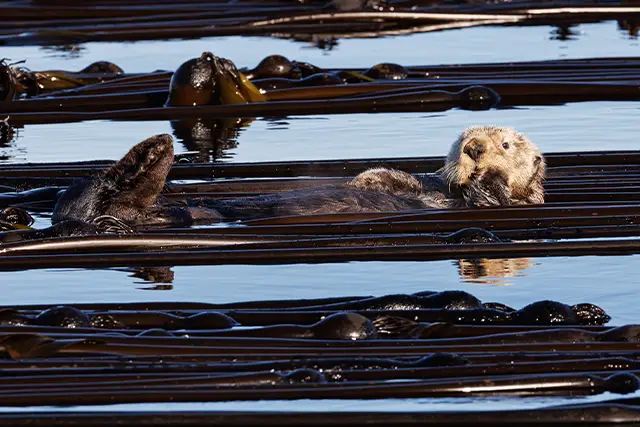
We needed to stretch our legs, so we pulled in at Pedder Bay Marina for an ice-cream. From here we had another try for sea otter – this time successfully in an area of kelp around Race Rocks where there were also large numbers of both California and Steller’s sea lions – he was lying on his back amongst the kelp quite happy to be watched and photographed, front paws folded on his chest. It wouldn’t have been right to go for more than half an hour or so without whales, so it was no surprise when we heard the distinctive blow of a humpback, and another, and another. Four, and then five humpbacks cruising and feeding in a nearby channel as the setting sun was becoming ever more golden.
 Finally, it was time to head north and back to Sidney – a brief glimpse of harbour porpoise on the way – and we arrived back at the jetty at just after 6.30pm, an hour later than planned, but after a truly incredible day of whale-watching. As our guide Oryan said as we got off the boats, “that was one of the best day’s whale watching I have ever had.”
If you'd like to discover the coastal waterways of the Salish Sea in British Colombia, or any other regions in Canada, you can get in touch with our expert team today.