Watch Humpback Whales Bubble-net Feeding in Alaska with Nick Garbutt

Watching and photographing humpback whales bubble-net feeding is a unique experience, and something that is a must see for any avid wildlife enthusiast. Wildlife photographer Nick Garbutt leads our whale watching trip to Alaska with a difference and describes what exactly this spectacle is and why you should consider joining him.
Few places in the world are as evocative, ethereal and scenically spectacular as the coastal regions of the Pacific Northwest. The intricate mosaic of islands, fjords, forests and mountains of the Alaskan Panhandle and British Columbia is an incredibly rich and biodiverse area that supports a wealth of wildlife.
Visiting the area for the first time had a profound effect on me, as few places I’d ever been felt so ‘spiritual’: and that’s coming from someone who prides himself on logic, rationale and reason and doesn’t have a ‘spiritual’ bone in his body. It’s hard to pinpoint the feeling. Perhaps a better phrase might be that the area instills a feeling of ‘connectivity’ with nature as the temperate rainforests and teeming inshore waters of the region, envelope and draw you in with their calmness, grandeur and serenity.
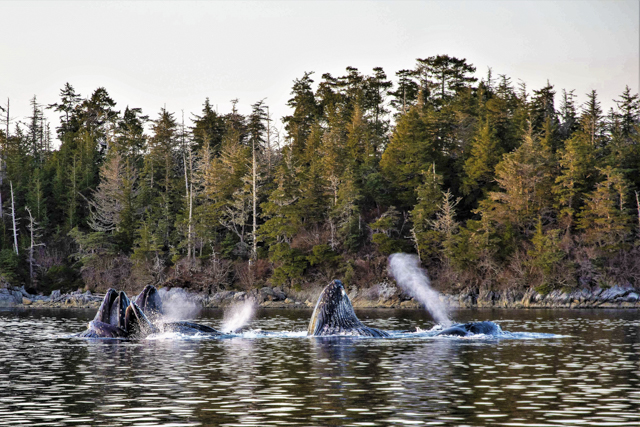 Part of the region’s charm is the ebb and flow of the annual seasonal cycle, where the frigid torpor of winter is gradually released with the onset of spring. This heralds the arrival of two crucial nomadic ocean species, firstly vast shoals of herring intent on spawning and second, pods of humpback whales seeking to break their six-month fast and gorge themselves on the bounty. There can be few more pulse racing sights than a group of ten or more humpback whales bubble-net feeding: simultaneously erupting through the surface of the ocean, mouths a gape and water cascading through baleen. The waters off the Pacific Northwest are renowned locations where this behaviour may be witnessed, but pinpointing time and place specifically can be challenging.
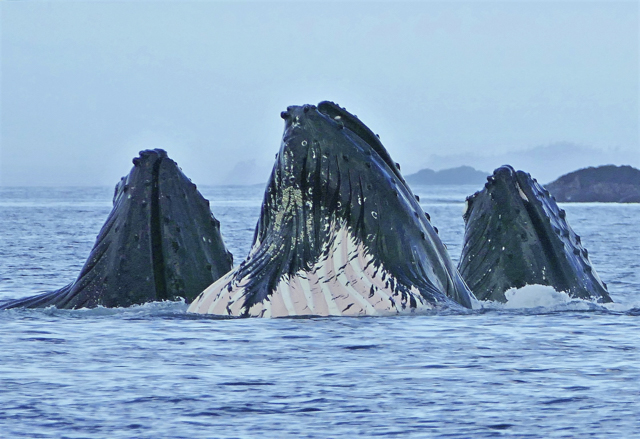 However, certain bodies of water surrounding islands in the Alaskan Panhandle, attract particularly vast schools of migrating and spawning herring in spring and sub-populations of humpbacks have learned to time their own migration to take advantage of this. Having given birth to their calves in the warm waters off Hawaii, some humpbacks specifically migrate to the waters around Baranoff Island and especially Sitka Sound, a renowned location for colossal schools of herring gathering between mid-March and early April. Having not fed for months, the humpbacks gorge themselves on the annually predicable feast: pods of 10 or more whales spend the entire day bubble net feeding and we will be there at the prime time to witness these tumultuous events. It is regular to witness between 30 and 50 and sometimes as many as 70 bubble net feeding events per day!
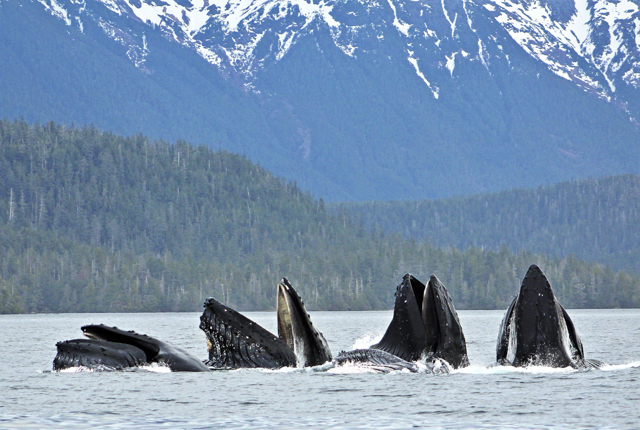 Groups of up to 18 whales first show their flukes before a deep dive, which triggers the beginning of a coordinated hunt. The hydrophone allows the crew to listen to the whales’ communications, as they coordinate their attack strategy. Having descended to great depths, the whales then swim in a spiraling motion beneath the herring school, expelling air from their blowholes, creating a containing curtain of bubbles that disorientates and corrals their prey. The whale group leader then emits a high-pitched feeding call that drives the herring toward the surface. Notified of this, photographers aboard our boat are given prior warning of the impending action. Shortly afterwards the whales’ calls increase in pitch and the sound of the rising bubbles and frenzied herring can be heard seconds before the eruption at the surface. Sometimes a 10-metre wide column of herring is forced out of the water just prior the whales' emergence. Enormous whale heads erupt at the surface with mouths agape and throat grooves bulging as the ‘marine soup’ flushes through their baleen plates. Instantly, several hundred gulls (numerous species) arrive on the scene, screaming and swarming above the upwelling waters full of herring. Some of the gulls even appear to take fish from inside the whales' open mouths.
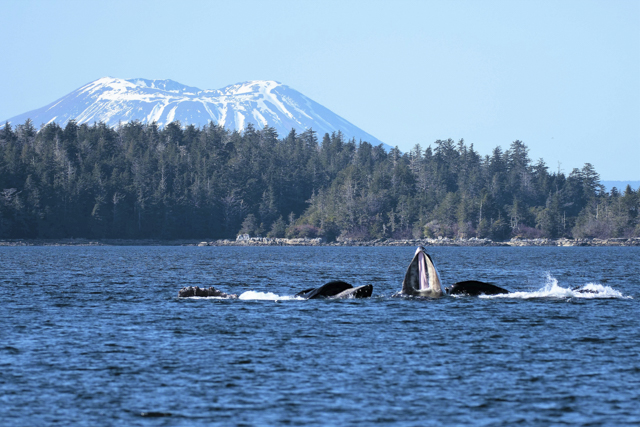 Spending seven days on the water will bring us right at the forefront of the action and maximise our time spent watching these fantastic creatures and this unique behaviour. In addition to the humpback frenzy, we can expect to encounter Stellar's sea lion, harbour seals, sea otters and bald eagle. With luck, we will also see Bigg’s (Transient) orcas.
Images by Neil McDermott
Join Nick on our Alaska's Humpback Bubble-net Bonanza trip, or to find out more information get in touch.