Wild dogs in Zambia - success!
Tuesday 17 November 2015 – South Luangwa National Park, Zambia:
This was the day we set off specifically looking for wild dogs. We had Thandy with us from the Zambian Carnivore Programme (ZCP), with her tracking equipment. It was going to be a long day as the plan was to go north into the Nsefu area. ZCP was aware of three or rour packs in the park, most of which included one collared dog, but they did not have a collared dog in the largest pack. The hope was that we would find this large pack and then call in a vet to put a collar on one of the dogs.
Things started well and soon after entering the park Thandy picked up a signal. This was from the collared dog in the Lower Lupande pack, one that had not been seen in the park for several months. Hopes were high in the vehicle! The signal was coming from an area of thick bush. There were some zebra and impala in the open ground between us and the bushes. Kanga, our guide, was explaining how Crawshay’s zebra are different to other zebra, but he stopped mid-sentence – all the zebra were looking intently at the same spot, exactly where Thandy’s direction finding kit indicated the collared dog was.
Driving off-road to go straight towards this spot was not allowed. We tried moving round one side, but the signal became weaker that way, so we quickly headed back and round the other side. Then someone saw movement in the bushes and the flash of something sort of dog-shaped. We continued heading around the side, staying on the road.
People! – not what we wanted to see. There was a group out on a walking safari. All the guides met for a discussion – the walkers had not seen anything, but they had heard a lot of activity and rushing around in the bushes – all consistent with game running from a predator. Then Kanga pointed out a number of vultures overhead. Everything was coming together and we knew we must be close, but still couldn’t see any dogs.
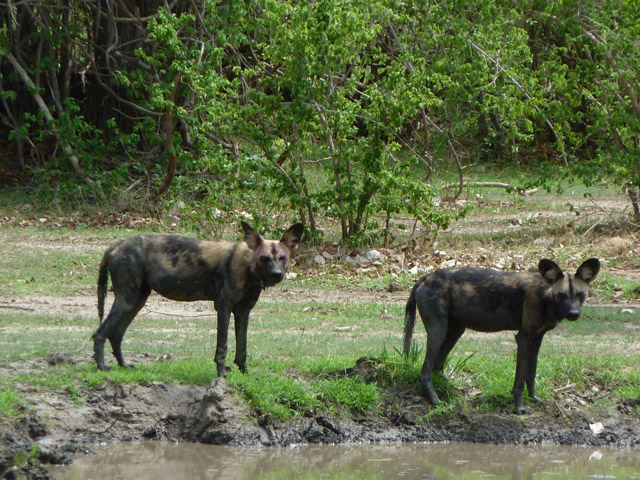 Kanga was not allowed to drive off-road – Thandy was, but she wasn’t allowed to drive the lodge’s vehicle. We all agreed that so long as there was evidence a vehicle had been there before, that constituted a ‘road’ – and we creeped nearer. Then, all of a sudden, there they were, a pack of six dogs - four adults and two pups.
The rains had started the previous week, so impala fawns were appearing everywhere, and one had become a small snack for this pack of dogs. We sat and watched as the pups argued over the scraps of the impala and rushed towards any vulture that dared to come too close. They seemed to be settled in that spot for some time, not planning another hunt, but they were constantly busy and active, very different to a pride of sleeping lions.
After about an hour we moved on to continue our planned trip north, through the park.
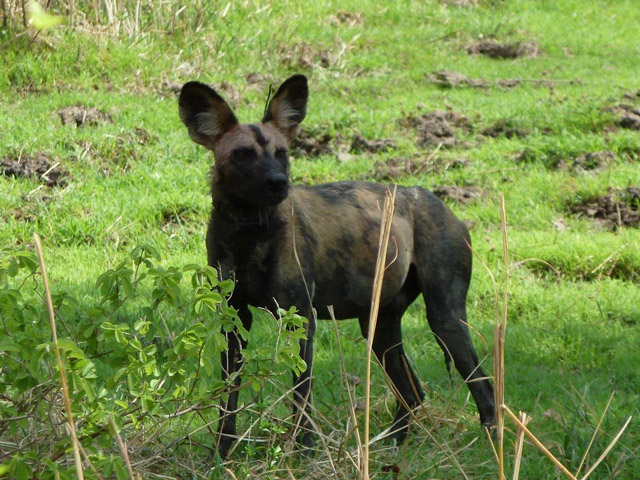 It was a long day and, although we saw lion later on, we never found the pack of dogs we were looking for. Indeed we did not see dogs again for the rest of the week. We picked up a signal from another pack one night when it was raining heavily in a thunderstorm. They must have been within 300 metres, but heading off towards the bush in those conditions would have been really stupid! And the following day we saw dog tracks in the wet sand, but no sign of the dogs themselves.
During the rest of the week we saw lion several times, and found leopard on three occasions, which all combined to make a fantastic trip – but the highlight was the privilege of that hour watching the wild dogs.
Jan travelled on our Carnivores of South Luangwa itinerary - a small group conversation tour focussing on wild dog populations in the area.