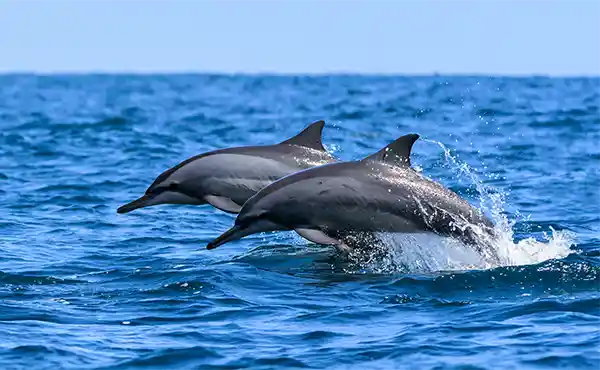
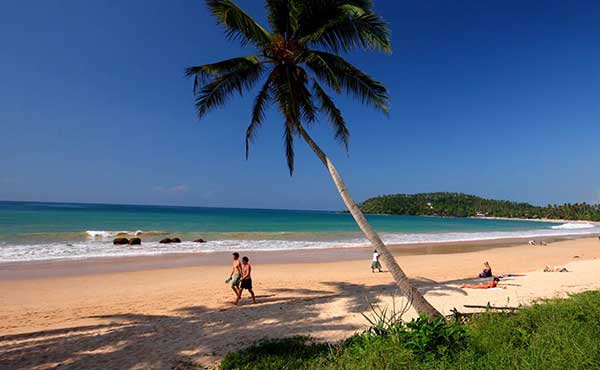
Mirissa is one of the foremost places in the world to see blue whales and sperm whales. Between December and April, when the sea is relatively calm, they arrive off the coast to feed in the rich waters.
The world’s largest mammal, the blue whale, grows to around 33 metres in length and weighs up to 150-180 tonnes; it lives individually or in very small pods, but frequently swims in pairs. Its blow rises several metres high in a tall column, and is easily observed at a distance. In Sri Lanka, whale watching was first mooted in the 1980s following the documentation of sightings of both blue and sperm whales off Trincomalee, on the east coast. Frequent sightings of resident and migratory whales, crossing from the Bay of Bengal to the Arabian Sea, off the south coast around Mirissa, and to a lesser extent off Kalpitiya, have made whale watching extremely popular.
The sperm whale has teeth in its lower jaw and feeds on fish and other animals such as squid, which inhabit deep water. Sperm whales are the deepest divers of all, reaching depths of two kilometres or more, and can remain over an hour without breathing. The front of their heads - the melon – is filled with hollow tubes that contain an oil known as spermaceti, which had great value as a lubricant, which is, of course, why the whales were hunted with such zeal. Its blow is small and bushy compared to that of the blue whale. Its blowhole is slanted forward, and angled to the left of its body, although this is not always discernible from the distance.
Three specially designed boats currently operate whale watching trips out of Mirissa. Trips last between three and four hours, depending on sightings and sea conditions. All boats have a roof that provides some shade, although you should still ensure you are well-protected from the hot tropical sun, seats, toilet and are equipped with life rafts, life jackets, life rings and communications equipment.
View suggested itineraries