This exciting trip idea visits prime birdwatching and tiger sites throughout northern India, including Corbett National Park in the Himalayan foothills and Ranthambore, as well as the Taj Mahal and historic Bharatpur.
India is a haven for an abundance wildlife and whilst it's well known for its tigers, it also supports well over 1,000 species of birds and this itinerary visits a number of locations to ensure you have chances to encounter a wide variety across varying habitats.
Whilst a capital city may not often be the first place one might think to look for birdlife, Delhi is quite the exception with both the Okhla and Sultanpur sanctuaries located nearby. After two nights in Delhi, you travel to Corbett National Park, home to about half the birds on the Indian subcontinent as well as one of the world’s largest populations of tigers.
Once you leave this mystical world behind, you journey south for a cultural stop in Agra to experience India’s most famous national monument, the Taj Mahal, before continuing onto Bharatpur, one of the finest waterbird sanctuaries on the planet, with over 400 recorded species.
Your trip concludes with three nights in Ranthambore National Park, one of India’s most renowned tiger reserves and home to 300 bird species and mammals such as leopard, sloth bear and, of course, tiger.
Suggested Itinerary
-
Day 1:
Depart UK
-
Days 2-3
:
Arrive Delhi; visit Sultanpur Bird Sanctuary & Okhla Bird Sanctuary
Arriving in Delhi this morning, you transfer to your hotel in the city.
During your stay in Delhi, you visit the city’s key bird sanctuaries. Okhla Bird Sanctuary lies beside the Yamuna River, at the Okhla Barrage, and is recognised as a haven for over 300 species.
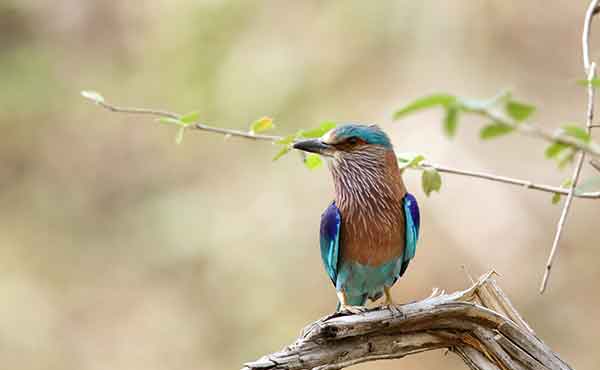
You also visit Sultanpur Bird Sanctuary, in the neighbouring state of Haryana, where around 250 species of birds may be found. Birds you may see between these sites include common hoopoe, paddyfield pipit, purple sunbird, grey and black francolins, Indian roller, white-throated kingfisher, Indian spot-billed duck, painted stork, rose-ringed parakeet, red-wattled lapwing, shikra, spotted owlet and green bee-eater. At Sultanpur you’re also likely to see rhesus macaque, nilgai and five-striped palm-squirrel.
Accommodation: Roseate House, 2-nights
-
Days 4-7
:
Safaris in Corbett National Park
You leave Delhi early and drive (six to seven hours) to Corbett National Park, arriving in the afternoon, in time for your first jeep safari.
India’s first national park is an important refuge for the wildlife of the southern Himalayan slopes and is renowned for its rich and varied mammal and reptile life – including one of the world's largest populations of tiger and the rare, bulbous-snouted gharial crocodile. It's home to more than 600 species of bird including great pied hornbill, tawny fish owl and, in winter, ibisbill. Located in the foothills of the Himalayas, in the broad valley of the Ramganga River, Corbett offers superb submontane and riverine views.
Accommodation: Tiger Camp Resort, 4-nights
-
Day 8:
Corbett National Park to Delhi
You take a final morning jeep ride, before leaving Corbett for your drive (around five to six hours) to the outskirts of Delhi.
Accommodation: Holiday Inn Mayur Vihar, 1-night
-
Day 9:
Explore Agra & The Taj Mahal
This morning, you travel from Delhi to Agra to explore the Indian cultural highlights of Agra Fort and the iconic Taj Mahal. The impressive Agra Fort is a UNESCO World Heritage Site and is considered the most important fort in India, from which the country was once governed. Built as a monument to love, the Taj Mahal is a visually impressive piece of architecture, with its marble exterior changing colour with the stages of the sun during the day.
Accommodation: Hotel Grand Mercure, 1-night
-
Day 10:
Birding in Bharatpur
Today you journey to Bharatpur and Keoladeo Ghana National Park, a Ramsar and UNESCO World Heritage Site and an important overwintering reserve for migratory birds. Notable species you may see include eastern imperial eagle, sarus crane and the elusive spotted creeper. Among the range of mammals you can look for are chital, sambar and golden jackal.
Accommodation: Laxmi Vilas Palace, 1-night
-
Days 11-13
:
Tiger watching in Ranthambore National Park
This morning you board a train from Bharatpur to Sawai Mahopur, the Gateway to Ranthambore. You spend the next three days at Ranthambore National Park, best known for its tiger sightings but also home to a host of other mammals, which include leopard, sloth bear, rhesus macaque and wild boar. Birdlife is excellent here, with upward of 300 species recorded. You explore the different zones within the park, hoping for a diversity of wildlife, including the chance to see tigers in their natural jungle habitat.
Accommodation: Tiger Den Resort, 3-nights
-
Day 14:
Return to Delhi
You have an opportunity for one last jeep safari before taking the train to Delhi, where you transfer to your hotel and have dinner.
Accommodation: Roseate Hotel, 1-night
-
Day 15:
Return UK