Japan: A Spectacular Winter Wonderland

It’s February, in the northern Japanese island of Hokkaido, and day 3 of our ‘Japan’s Winter Wildlife’ holiday. We’re here to see the beautiful courtship displays of the red-crowned crane, Japan’s most iconic bird; Blakiston’s fish owl – the second largest owl in the world; and the mighty Steller’s sea eagle.
First stop, the cranes. It’s early in the morning at Otowa Bridge on the Setsuri-gawa River. Mist rises veil-like from the water, spreading out like a super-cooled shroud across the surrounding snow and ice. The vague outlines of cranes are visible, but not close; from time to time one flies off and settles upstream. It’s picturesque, an iconic sight. Our time is divided between watching, full of awe at this natural wonder, and trying to capture images, freeze-frame the moment with our cameras.
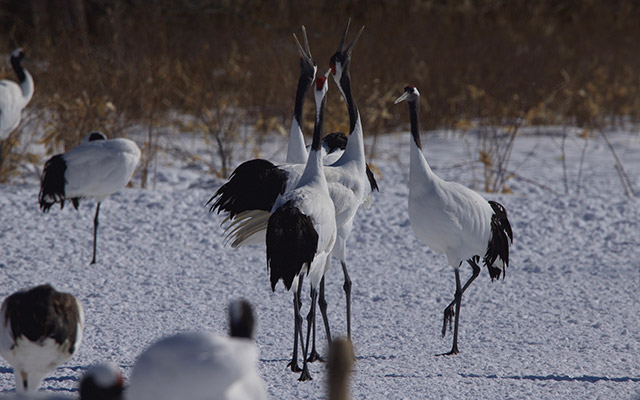
Numbering only 33 individuals worldwide, and with only 20 existing in Japan in 1952, the red-crowned crane is a conservation success story. The species has been brought back from the brink of extinction by a feeding programme at Tsurumidai a couple of kilometres to the south-west of Otowa Bridge, and there are now around 1,500 birds in the country. Ours was the first of two highly successful trips to Japan this February. Both groups had superb views of the cranes displaying – watching and photographing their elegant and elaborate ritualised courtship movements, amongst the crisp snowy mists of an early Hokkaido morning was an unforgettable sight, and a perfect beginning to the tour.
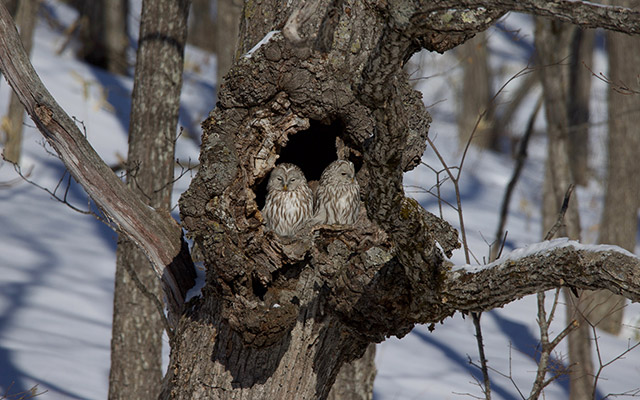
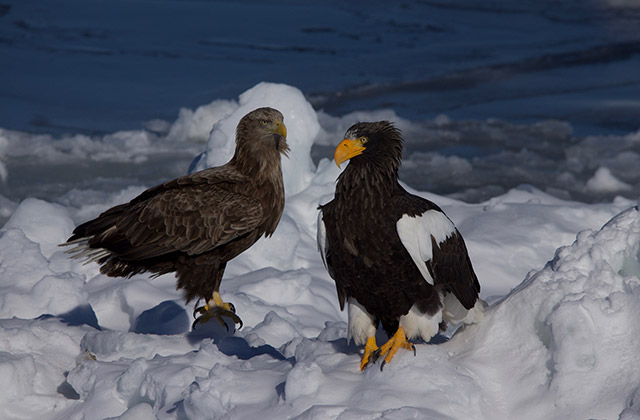
Sika deer, white-tailed eagles and fantastic views of Ural owls were amongst the other early highlights of both trips, and excitement was building as we headed to our next stop, the small coastal town of Rausu, which to a keen birder means one thing – Steller’s sea eagle! In recent years, Rausu has gained a deserved reputation as being the best place to get close views of one of the world’s most sought-after birds of prey, the Steller’s sea eagle. One of the three largest eagles (harpy and Philippine being the other contenders for the title) in the world, the Steller’s has a striking appearance – dark brown plumage with white wings and tail, and a bright yellow beak and talons.
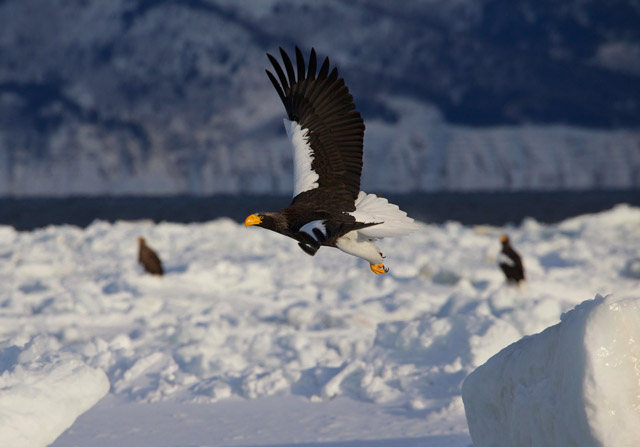
Our group was lucky enough to get out onto the pack-ice to see and photograph these most photogenic of eagles; the ice, ocean and birds with the snow-covered landscapes on either side – Hokkaido to the west and one of the Russian Kuril Islands to the east – made for a memorable excursion. Our second February group saw the eagles fighting on ice within the harbour at Rausu; in addition, they enjoyed superb prolonged views of the eagles fighting and competing for food on the ice on Lake Sunset.
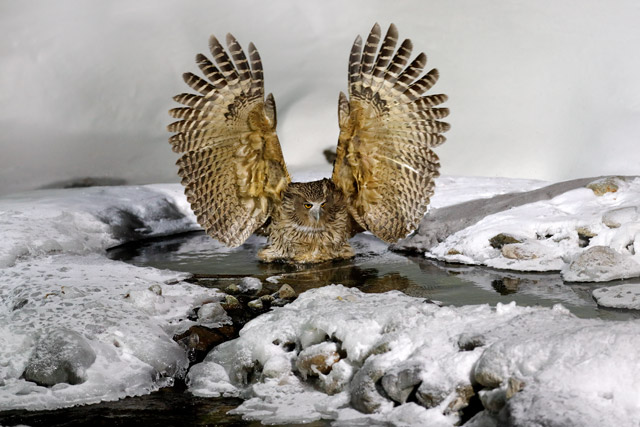
And there was more excitement to come for some of our second group – on day 6, having put in numerous patient hours of waiting and watching, those who had stayed up late (10.30pm) were at last rewarded with views of the endangered Blakiston’s fish owl – at very close quarters as it fished in the little pool outside their hotel window.
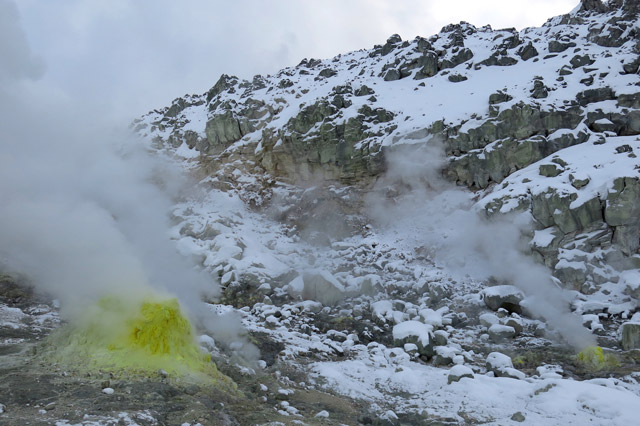
Among the other bird highlights (from both trips) in Hokkaido were Japanese and oriental crows, black-eared kite, eastern buzzard, whooper swan, dusky thrush, the very attractive varied tit, greater scaup, common goldeneye, harlequin and tufted ducks, goosander, red-breasted merganser, little grebe, glaucous, slaty-backed and vega gulls, black and white-winged scoters, brown-eared bulbul, hawfinch, Japanese wagtail and Japanese pygmy woodpecker. And although the cold conditions had been a challenging at times, the resulting snow-covered landscapes and atmospheric mists, yellow mounds spewing out sulphurous fumes through thermal vents, hot spring baths and some delicious meals were among the many other highlights during our time in the frozen north.
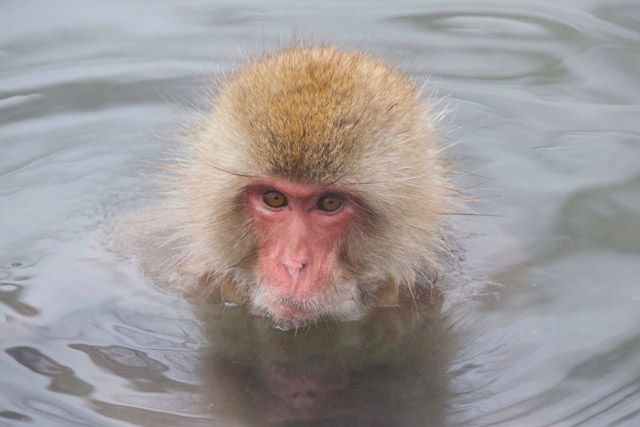
For the second part of the holiday, we flew south to Tokyo and then took the bullet train (shinkansen) to Nagano. Next stop was the Jigokudani (Hell’s Valley) Monkey Park – where we were hoping to see the park’s famous Japanese macaques bathing in the local hot springs. It is a 1.6-kilometre walk through forest to Jigokudani, where troops of Japanese macaques bathe in a hot spring specifically set aside for them. A few ‘snow monkeys’ were bathing when we arrived, with many more scattered in the surrounding area. Snow carpeted most of the ground and many macaques searched in the snow for grain that had been thrown out by park staff. Despite the snow we found the conditions relatively mild, perhaps because of our icy introduction to Hokkaido. One tourist was even wandering around in a T-shirt, much to our amazement – it wasn’t that warm!
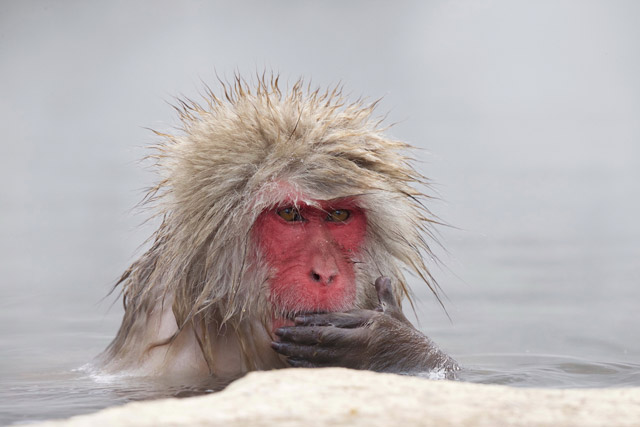
The macaques largely ignored us, simply moving around us as they wished, often very close by. Even so, one member of our group was shouldered out of the way by a macaque walking along a railing. We also, after much scanning, managed to see a Japanese serow through a telescope before it was time to head back to our hotel. The bathing monkeys are an iconic photographic opportunity (though the steam rising from the water presents a challenge), and both groups were able to see and photograph the famous ‘snow monkeys’ sitting in the thermal waters.
Having seen the snow monkeys, it was almost time to head back to Tokyo and say sayonara to this most hospitable of far-flung lands. However, we had one last treat in store – a visit to the Zenko-ji Temple in Nagano Prefecture. The main hall in the temple grounds is a designated Japanese ‘National Treasure’ and was reconstructed in 1707. Set within a very large area, with multiple buildings, the site includes Buddhist sutras and a temple bell with a 1632 inscription. We had a guided tour around several buildings, and learnt about the temple’s history before wandering about the grounds, where we spotted pale thrush and oriental turtle dove.
It’s impossible not to be beguiled by Japan – a heady and, at times, curious mix of the modern and ancient, of traditional ryokan with tatami mat floors and skyscrapers, delicious centuries-old food and burger outlets, futons and temples, high-tech and robot cafés. We had been privileged to see beyond the the sprawling metropolises, and venture into its wild places, guided by charming locals who could never do enough to make our stay comfortable and enjoyable. Most of all, we headed west impressed by its wildlife, people and stunning winter landscapes.
Join us on our Winter Wildlife tour of Japan for exceptional encounters with some of the country’s iconic wildlife, and superb photographic opportunities. Contact us for more details or to book.