In Bagheera’s Footsteps: The Exuberant Wildlife of Nagarhole

Bagheera stretched himself at full length and half shut his eyes. “Little Brother,” said he, “feel under my jaw.” Mowgli put up his strong brown hand, and just under Bagheera’s silky chin, where the giant rolling muscles were all hid by the glossy hair, he came upon a little bald spot.
In these words Kipling describes in his Jungle Book (far wilder and more wonderful than any of the films) the moment when Bagheera the black panther shares with the man cub Mowgli the fact that he is scarred.
From bittersweet experience, I know all about scarred panthers. Last year in April I went to Nagarhole, in the South Indian state of Karnataka, to scout this glorious park for a new Wildlife Worldwide tour. I had a second mission too. Since Kipling’s fictional Bagheera there has never been a panther as well known and well loved as the black male who lives in Nagarhole today. Greeted by naturalist Vijay as I reached Kabini River Lodge, the charming base of our new tours, I asked him whether I would see the panther. ‘One week here?’ he replied with his characteristic enormous smile and head wiggle, ‘pukka you will see him.’
I did not, despite heroic effort by all the staff at the lodge. Two weeks before my arrival he had been in a savage fight with a powerful spotted male. The panther had been photographed with a vicious gash to his face and not seen since. During my fantastic week in Nagarhole in 2018 I saw many leopards and tigers, herds of Asian elephants, Asian wild dogs almost daily, but no black panther. Having seen the images of his disfigured face, I left India convinced that he was dead.
He was not. As soon as my jet touched down at Heathrow, I turned on my phone and received three notifications from friends in Nagarhole with photos of the panther from that morning, the day after I left the park. On his face, like Kipling’s Bagheera, he bore a scar telling of his past.

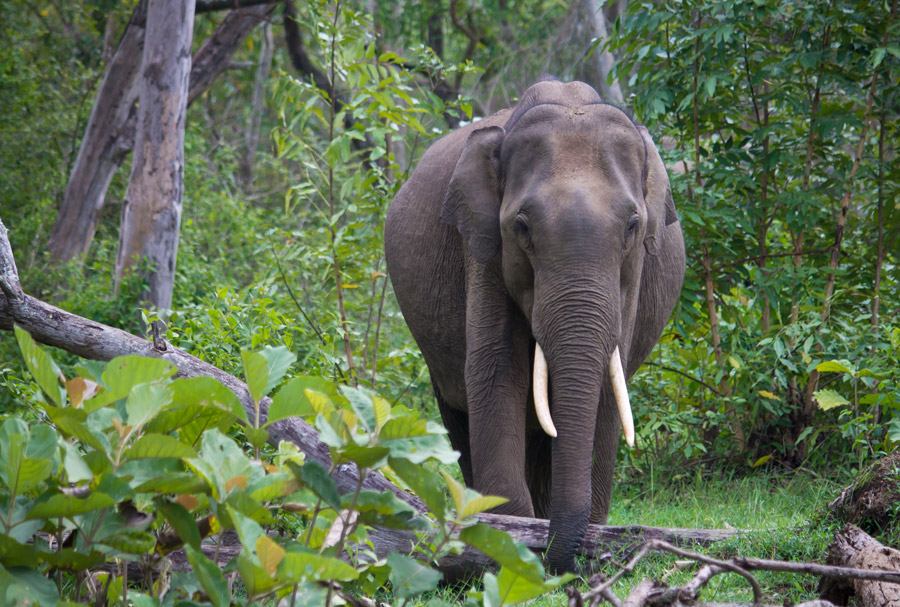
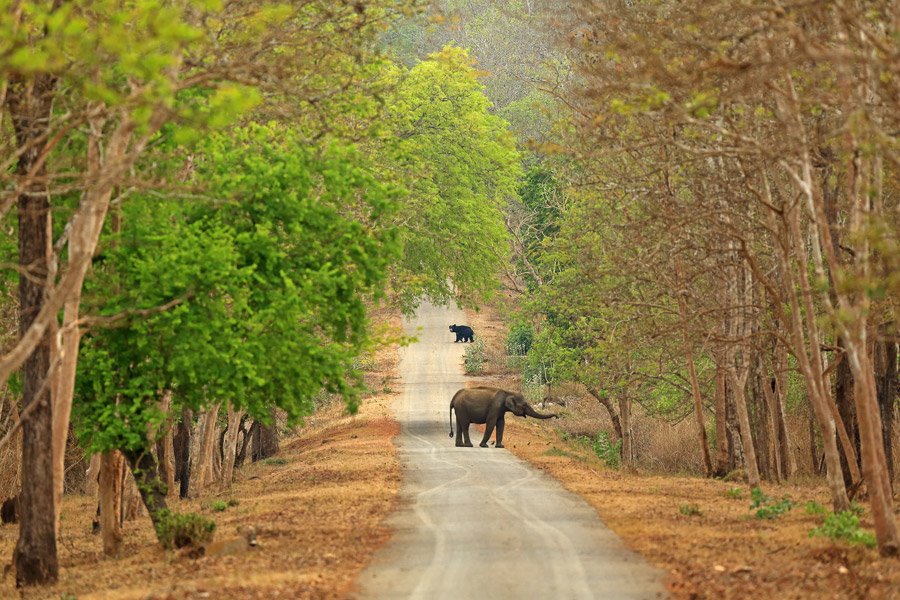
Challenge accepted. This March I led the first departure of our magnificent Nagarhole’s Tigers, Wild Dogs & Leopards. The park was every bit as wonderful as I remembered. The forest was loud with the chimes of coppersmiths and the rolling purr of white-cheeked barbets. The broad rides along which we drove were thronged with chital – bachelor herds with huge antlers in velvet and females with leggy fawns – and on their rumps were jungle mynas. Peacocks, their exquisite trains shimmering, perched in trackside trees and grey junglefowl cocks marshalled their hens through the edge of the forest. In tall trees handsome Indian giant squirrels scolded and quivered their ridiculous tails, while Asian elephants bashed through the undergrowth nearby.
Even discounting its carnivores, this park, which has a very strict limit on the number of vehicles entering, is a serene and fascinating place to spend a week, far calmer than the tiger reserves on Central India’s beaten track. But the carnivores here are far from shy. Stripe-necked mongooses – surely Asia’s most beautiful mongoose – are common and seem blithely unbothered by vehicles. Ruddy mongooses are less common but nonetheless reliably seen. Sloth bears were seen by two of our three groups too, a rare feat in a park so laden with tigers.
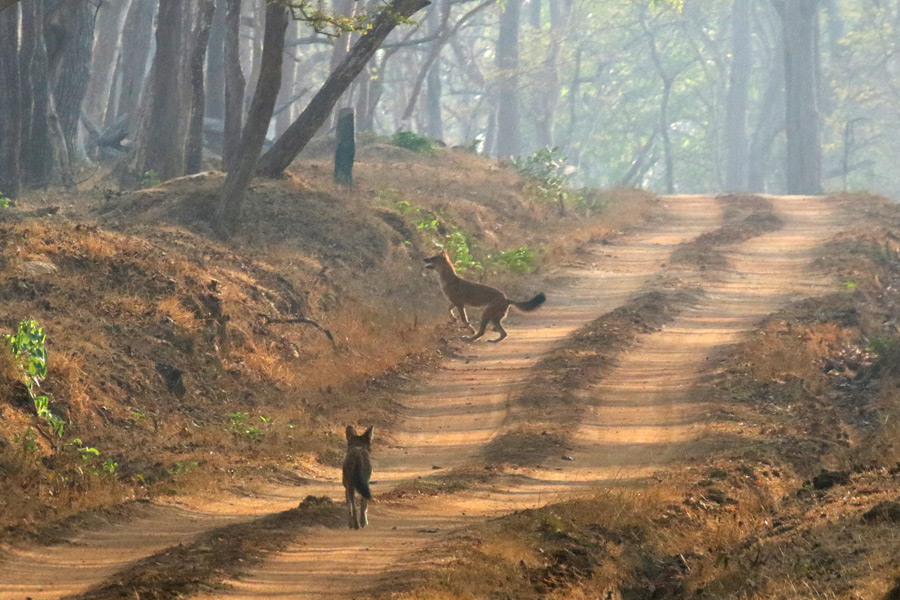
As for Asian wild dogs, they are embarrassingly easy in this lovely park. This season there are two packs in the areas which tourists are permitted to visit. One pack, an established alpha pair and their three full-grown offspring, lives around the forest guesthouse in the park and is seen every day, exhibiting no fear of vehicles. A second pack, a young alpha pair and their five small pups, inhabits the border between tourist zones A and B. In addition to seeing the guesthouse pack on several occasions, my group witnessed the harrowing but remarkable spectacle of the adults of the second pack bringing down a chital buck and then fetching their playful puppies to eat it.
But even more thrilling than the dogs were our encounters with cats, not just for my group but also for the following two, expertly led by superb local naturalist and film-maker Ashwin HP and by Wildlife Worldwide’s award-winning photographer Bret Charman. Each of our groups had several excellent meetings with tigers, including males and the two mothers (with and without their cubs) which currently inhabit the tourist zones. All three groups also saw numerous leopards, including well-grown cubs lying in trees and – exceptionally – an adult male bursting from nowhere to steal an Indian giant squirrel before their eyes.
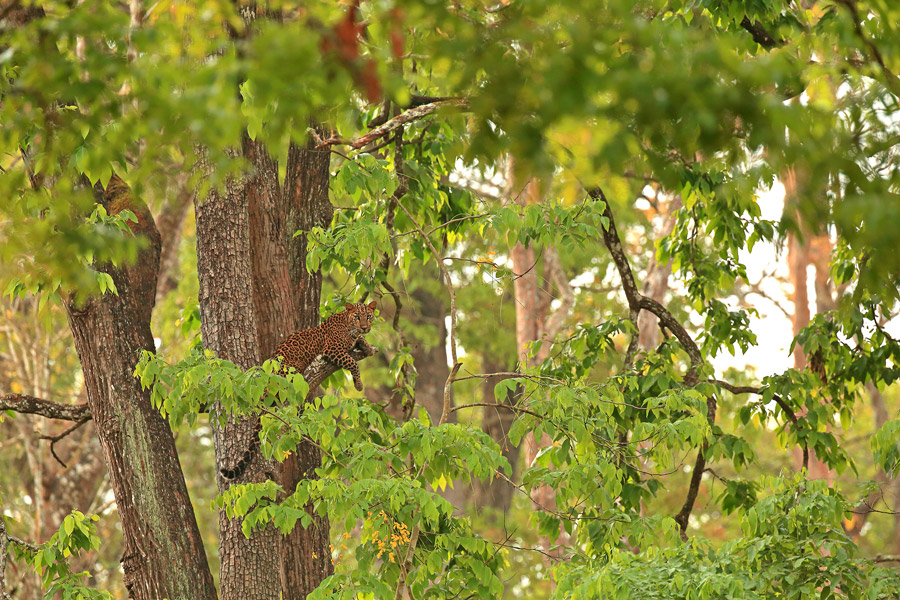
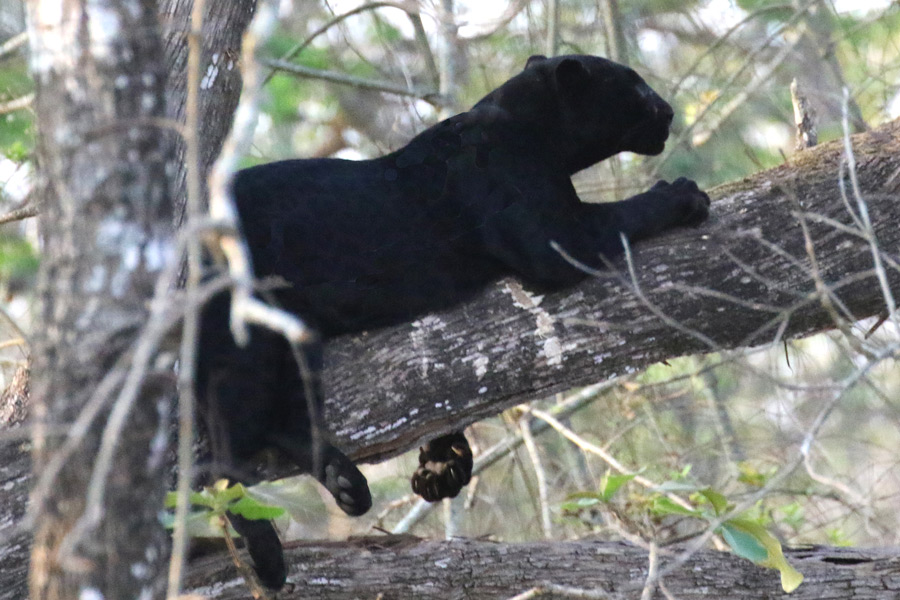
But what of the leopard with the scar? The leopard described by Kipling as ‘inky black all over, but with the panther markings showing up in certain lights like the pattern of watered silk.’ The leopard which evaded me by just hours last year. All three of our groups saw this once-in-a-lifetime cat too. Now at the peak of his strength, emboldened by his muscles and by the attention of females, he has often been seen this season. Two of our groups saw him draped in a tree, one of them at length while he guarded an unseen spotted female nearby. One lucky group saw him – with no other vehicles present – saunter along the track beside them and stop to bathe in the dust. All of us were spellbound.

There is every reason to hope the black panther will occupy the tourist zone of Nagarhole a year hence when we run three more departures of this tour. But even should he have moved, or lost a second battle with his spotted neighbour, the wildlife of this gorgeous park – with its lovely lodge and fine guides – will still be exceptional and still hugely worth a visit.
Images courtesy of David Stott, Jon Isaacs & Bret Charman (all images taken on our 2019 Nagarhole tours)
Join us next year in Nagarhole on this extraordinary small group wildlife tour to discover some of India's iconic mammals, including - with luck - one very special cat. Contact the Wildlife team for more information.