I was lucky enough to visit Japan in June to recce our exciting upcoming tour, Hokkaido’s Summer Wildlife, and it didn’t take me long to realise that ‘wild’ is the perfect description for this wonderful destination.
Hokkaido, Japan’s northernmost main island, is widely regarded as one of the country’s last great wildernesses. Over the years, Wildlife Worldwide has offered trips to Japan during winter, when the dramatic landscapes are covered in snow and ice. However, come summer, as the snow melts the scenery bursts into life; birdsong fills the air in lush forests, butterflies and vibrant wildflowers bloom, and some of Hokkaido’s most iconic wildlife begins to stir.
On first impression, much of Hokkaido looks a little like the British countryside, though these similarities – excitingly – end fairly quickly when you start spotting species that would be rather unusual on a country drive back home. My favourite encounter was a pair of beautiful white-bellied green pigeons that flew past.
Visit the right places, and you’ll find expanses dedicated to nature, such as the Shiretoko Peninsula, a magnificent wilderness where mountains and forests meet cliffs and the sea. It was here that my Hokkaido adventure began, as I was shown some of the very best wildlife the peninsula has to offer. At the top of the list were two of Hokkaido’s summer icons: orcas and brown bears.
Each summer, up to 200 migratory orcas visit the waters off the coast of Rausu, where their eagerly anticipated return is reflected throughout the town in orca-related shrines and artwork. After boarding a boat and heading out to sea, it took just half an hour to realise this was going to be something very special. We hadn’t simply found a pod of orcas – they showed an interest in us, surfacing right next to us as they interacted, played and tail-slapped. I was even lucky enough to see a spectacular breach.
The next few hours continued in much the same vein, with multiple pods interacting and playing, often curiously approaching the boat. By this point, I had rather lost the ability to concentrate on anything else, and I came back with far too many photos!
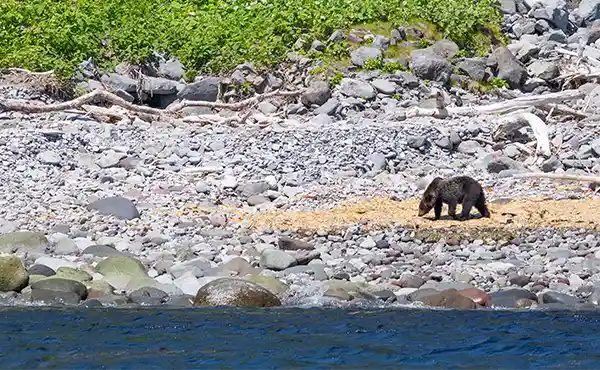
Also best observed by boat, Shiretoko’s famous brown bear population proved just as memorable, albeit in a very different way. From the ocean, I could see that beyond the odd building lay forest, forest, and yet more forest. Nature is free to roam here, and though this makes brown bears trickier to find, it made our first sighting all the more special: a bear scouring a rocky beach for food.
Sightings are generally from a distance as boats cannot reach the shallows, but this has its payoffs, allowing extended time observing the bears amble along at their own pace. However, this is a land that lives with bears. They can be encountered on any walk or boat cruise, and I even had a rather dramatic reminder of this when one crossed the road less than ten metres ahead of my vehicle!
Aside from these two summer spectacles, wildlife abounds. Ezo sika deer, often with fawns, can be found almost everywhere, while close encounters with Ezo red foxes are common. At night, the weird yet endearing Japanese raccoon dog emerges. Seabirds were central to the experience, with spectacled guillemot, black-footed albatross, rhinoceros auklet and flocks of shearwaters adding to the feeling that I was truly immersed in nature.
Inland, forests proved equally rewarding places to find a wonderful variety of birdlife, including Latham’s snipe, which I could always hear before I saw, alongside melodious songbirds such as African stonechat and warblers. Japanese pygmy and the striking black woodpeckers, however, became something of a challenge: I could hear them hammering away, but finding them was another matter, making even the briefest glimpses extremely exciting.
After Shiretoko, I was given a snapshot into how wonderfully varied Hokkaido’s summer wildlife and landscapes are. A stop at Sakura Waterfall offered an enjoyable chance to witness the summer migration of cherry salmon as they hurl themselves up the falls. Fun to watch, but an intense feat of fitness for the salmon as they battled upstream to breed. A fascinating visit to Mount Io, on the other hand, was a striking insight into the geological forces that have formed this extraordinary land – and, conveniently, created Hokkaido’s lovely warm onsens (hot springs).
The Notsuke Peninsula showcases a different habitat altogether, with dense eelgrass that attracts spotted seals each summer, turning the waters into a hive of activity. On land, the peninsula’s immense sandbar is renowned for its birdlife, so much so that during just a brief stop, I got my bird fix for the day with sightings of Eurasian skylark, Latham’s snipe, white-tailed eagle, black kite, African stonechat, red-breasted merganser and many others. I was also treated to more Ezo red foxes and larger herds of Ezo sika deer, which I could quite happily have watched all day long.
Cape Kiritappu brought yet another highlight for me, as a population of wild sea otters have made the base of the rugged cliffs their home. It’s now one of the most accessible places in Japan to see these adorable animals, with the clifftops providing a vantage point to watch their entertaining, frenetic activity below.
Finally, after yet another dramatic landscape transition, I found myself in the world-famous Kushiro-shitsugen National Park and its vast expanse of wetlands, grasslands, marshes and bogs. Here, I hoped to encounter an avian icon: the red-crowned crane. Once thought to be extinct in Japan, they’re now a regular sight in Hokkaido, not just in the marshes but also in the surrounding farmland. Summer brings a special chance to see lifelong couples rearing their already impressively large chicks – a testament to the impressive conservation effort that brought this magnificent species back from the brink.
Overall, Hokkaido left me truly captivated. The excitement lies in never quite knowing what you’ll find, because every turn, whether in a forest, out on a boat, across farmland or beside marshes, could bring new and fascinating encounters. Hokkaido’s incredible wildlife is, without doubt, the focal point, but it does take some searching, and it’s this that makes the experience so exciting.
What stayed with me most was the feeling of having experienced the landscape as a whole rather than simply ticking off wildlife sightings. The mountains reflecting in the Shiretoko Goko Lakes, Pacific swifts darting around immense cliffs as the sun sets, and the unique and friendly culture (not to mention the excellent food) all combined to make the experience feel so much richer. That, ultimately, is what makes Hokkaido such a special destination in summer.
If Jack's wildlife trip to Hokkaido has inspired you to visit this fantastic Japanese island in summer, discover our Hokkaido's Summer Wildlife tour today, or for all tours, visit our Japan destination page. For further guidance, contact our friendly team.
Related inspiration
If you're inspired by this article, you may be interested in the following:
From steaming volcanoes and caldera lakes to towering snow-capped mountains, swathes of primaeval forests and rugged coastlines, Hokkaido is Japan’s wildest island. During the summer, wildlife abounds, with brown bear, orca, fin whale, sea otter and spotted seal all to be encountered.
Find Out More about Hokkaido’s Summer Wildlife