My Lockdown Wildlife Experience…

Like much of the UK and indeed the world, my wife and I have been working from home for the past seven weeks and whilst it has undoubtedly posed a few challenges, one of the big pluses to emerge has been having the time to enjoy the wildlife in our small garden.
Located on the edge of a village in the Meon Valley in Hampshire, we’re within a stone’s throw of the South Downs National Park and over the years we’ve worked hard to encourage wildlife into the garden, planting a range of insect attracting bushes & flowers, installing nest boxes and through the provision of bird feeders. However, it's only in the last few weeks that we’ve had the time and motivation to experiment with some of the ideas that we’d been pondering over the years to capture our daily and nightly visitors on film. Some have worked better than others, but for the most part we’ve been delighted with the results and it has provided a very welcome distraction to the monotony of lockdown life.
I’ve always been a little obsessed with camera traps and it’s one of the first items to go in my bag when I’m travelling in search of wildlife. It opens up another world and every time you check it, it’s like opening a present on Christmas morning, you never know what you’re going to get! It was through a camera trap that we realised we had the occasional badger passing through the garden when we first moved in around six years ago. At the time we’d only seen a handful of live badgers in the wild and I vividly remember the elation that my wife and I felt when we realised that we’d had a badger in the garden. We were both bouncing off the walls and with that knowledge we started to leave a few peanuts out. The badgers gradually began to visit more frequently and with time, we’ve been able to gain their trust and can now observe them in the garden from around five metres. Depending on the prevailing weather conditions, we’ve had up to seven individuals at one time and often in the company of one or two foxes, but it varies enormously from one day to the next. If the weather is wet, making for easy digging conditions for worms, we don’t get a look in! We’re also very strict with the number of nuts we put out and will often not feed for an extended period, ensuring that the badgers are not dependant on us.
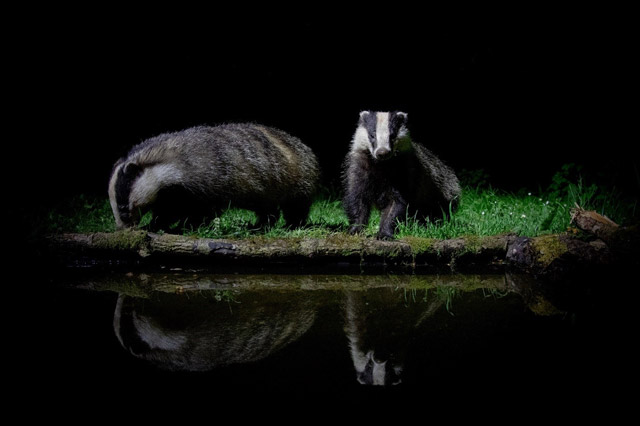
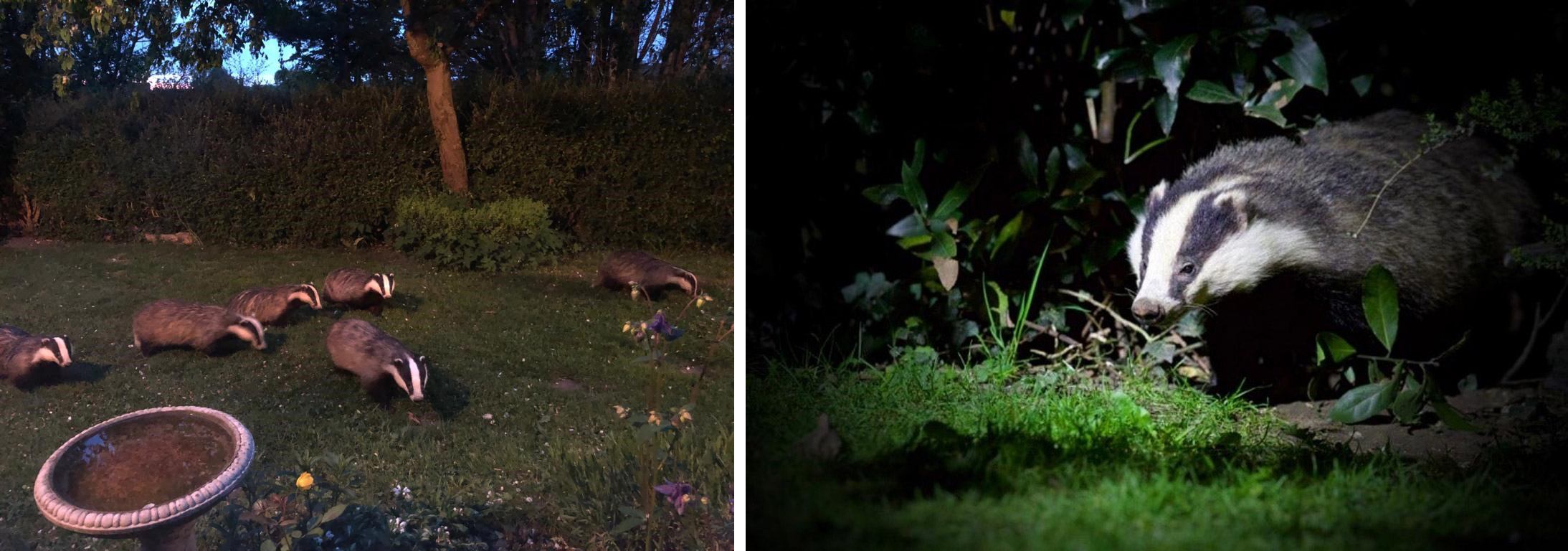 With the aid of an outdoor security light, we’ve taken plenty of blurry iPhone pics over the years (above left), but since lockdown, we’ve tried to do a little better, and with some additional torch light we’ve managed to get some sharper results (above right). We also dug a small pond with the aim of trying to get a photo of a badger with it’s reflection. The first pond proved too small and didn’t provide sufficient surface area for the reflection and so we upscaled to a large square drip tray and this has been working very nicely (see below).
 With the aid of our trusty camera traps and a recently installed IP Wi-Fi Camera which allows us to view our garden from our phones, we’ve been able to observe some fascinating social behaviour, both between the badgers and between different species. It’s quickly become apparent that the badgers dominate the foxes, the superior bulk of the badgers allowing them to out muscle even the most determined fox. We’ve also established that we have a very healthy hedgehog population, dispelling the notion that badgers are responsible for the decline in hedgehog numbers. Indeed, on several occasions we’ve seen the two species feeding side by side!
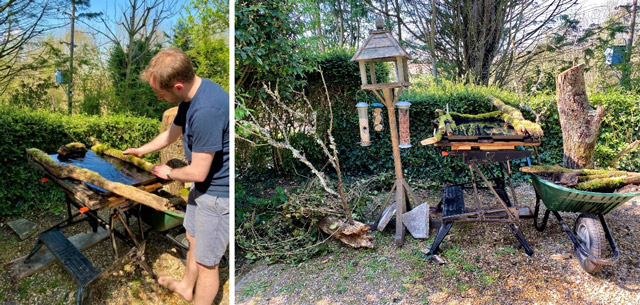
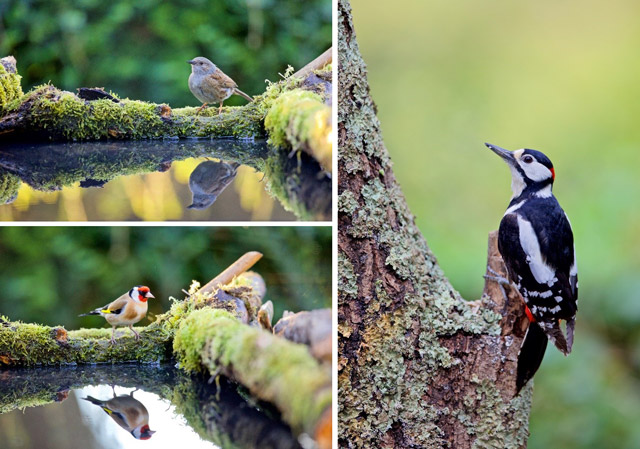
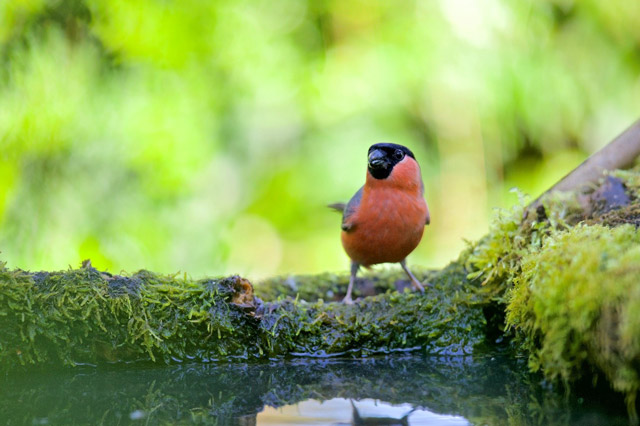
It’s a similar story with the birdlife in the garden. The feeders attract a good range of species, but capturing photos was always a challenge and invariably those we did get were quite unnatural – typically a bird perched on or clinging to a feeder, and usually at range. With space at a premium, we decided to construct a makeshift photography station on the driveway. It consists of a lichen covered log set in a wheelbarrow, a DIY reflection pool made from the tray of an old dog crate and a more traditional bird table. Viewed collectively it looks a bit of a mess (see below) and I’ve no doubt our neighbours think we’re mad, but we’re starting to get some very nice results.
 Positioned within a few feet of a window, the birds were initially quite skittish, but have become increasingly bold, first great and blue tit, and now coal tit, goldfinch, greenfinch, bullfinch, dunnock, robin, wren, nuthatch and great-spotted woodpecker. Goldcrests and the occasional firecrest can often be seen and heard in the conifer opposite and our hope is that we may be able to lure one of these diminutive gems down for a drink.
 It’s been all action with the three nest boxes we have up, but far from as we expected. The nest cam box that we’ve had for a few years and that has previously always been occupied by blue tits, again attracted a pair that began nest building before being kicked out by a pair of house sparrows. The house sparrows have subsequently filled the box with nesting material to the point that it's obstructing the camera, but we don’t think they’re breeding yet. Elsewhere, great tits have nested in the woodpecker box and after a few minor alterations to the entrance (!) a male great-spotted woodpecker is roosting in the tit box (see below).
All images by Dani Free
It's been a crazy few weeks in the garden and we’re looking forward to seeing what unfolds in the coming months – we’ll be sure to keep you updated!