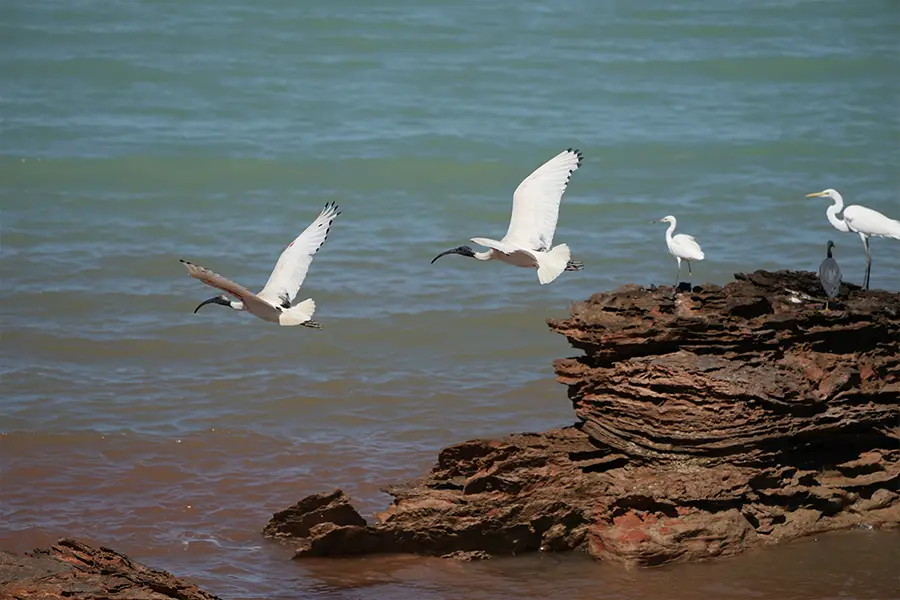
Widely known for its pearling industry, the coastal town of Broome, in the Kimberley region, is of international importance for migratory birds en route between their breeding grounds.
Broome occupies a peninsula, on the eastern side of which Roebuck Bay is of international importance for migratory birds en route between their breeding grounds in northern Asia along the East Asian-Australasian Flyway. Millions of waders or shorebirds feed on the intertidal mudflats and roost at high tide on the red sand beaches; although the largest numbers occur in summer, many young birds remain for the first two years of their lives. The Broome Bird Observatory, close to the northern shore, was established in 1990 to study the birds, learn how to protect them, and educate the public.
A mixed colony of some 50,000 flying foxes and little red flying foxes lives year round in the mangroves next to Broome's small jetty. These are key pollinators and seed dispersers for native trees and plants, and before flying out at dusk each evening they chatter and socialise loudly.
Pearling started with the harvesting of oysters for mother of pearl in the 1880s and later developed into the farming of cultured pearls. At first the area’s aboriginal inhabitants were forced to dive with little or no equipment, but when slavery was abolished this dangerous job was given to Asians – particularly Japanese, who were highly valued for their experience. The wealth derived from the pearl beds did not come without cost, and Broome’s Japanese cemetery has the graves of more than 900 divers who lost their lives. The influence of Japanese culture is celebrated in the annual festival of Shinju Matsuri – 'festival of the pearl'.
Outside town in the intertidal zone at Gantheaume Point you can see dinosaur footprints that date from the Early Cretaceous in age i.e. approximately 130 million years ago. These include the largest known tracks of all – 1.7 metres long – thought to be those of a sauropod, which is estimated to have been seven to eight metres tall at the hip. In 1996 some prints were cut from the rock and stolen, but have since been recovered. Plant fossils are also preserved extensively in Broome’s sandstone here and at other coastal exposures further north.
Between March and October Town Beach at the eastern end of the town, you can see the famous 'Staircase to the Moon', when the combination of a receding tide and the full moon rising over the exposed tidal flats creates an optical illusion that there is a staircase all the way to the moon – a stunning natural phenomenon!
View suggested itineraries


 LUXURY VESSEL