Flying Vicariously

The freedom to fly must be enjoyed vicariously, for now, through our feathered friends. Darting at will from one garden to the next in the case of the robin and migrating from one continent to the next in the case of the swallow. I muse, if given the green light, would our desire to travel propel us on an arduous six week epic journey to reach the safari lodge, as our current arrivals have just done in reverse from Namibia and South Africa (albeit instead to a dilapidated stable block..).
Ironically, I was due to travel to Namibia this month and instead find myself confined to a smallholding in North Devon which immediately borders a fisheries lake (not a bad place to be I accept). As I watched the swallows arrive from Namibia, with a mingle of admiration and envy, a shadow, both literal and figurative, was cast over them by another migrant from Africa.
Whilst down by the lake searching for signs of otter, standing *a responsible 2+ metres of course* from my neighbour Richard, busily discussing the smell of otter spraints and where to place the camera trap, there was a collective ‘thwack’ as our jaws hit the lake bank at an unexpected but unmistakable osprey.
 Adult female osprey named Morven – white ring inscribed in black PE (born 2003). Image by Sarah Malcolm
In my 26 years living in North Devon, I had never seen an osprey here. Granted, for the first twelve years I probably would have expected to see a burly Welsh rugby player if someone shouted ‘Osprey!’ (education courtesy of my Welshie mother).
Fortunately for us, this formidable fish-eating bird was in no hurry to complete the final stretch of their journey and settled in for a short time to fatten up on trout. Osprey undertake a long and lonely migration. Although they have a vast global distribution, most that breed in the UK over winter in Senegal and neighbouring West African countries. Noticing a white band, inscribed PE in black on the left leg, I managed some photographs, which we sent off to the Roy Dennis Wildlife Foundation. As it transpires, this majestic bird has been very well documented, and we very quickly learnt her story.
Demonstrating the wonders of data collection and sharing, it was revealed that we could start calling ‘The Osprey’ by her given name ‘Morven’; an adult female osprey that was ringed as a chick by Mick Canham at a nest on Forestry Commission land near Keith, Moray on 8th July 2003.
This is a really interesting bird that Roy satellite-tagged as an adult in Moray in northern Scotland in 2008, and called Morven. The satellite data showed that she wintered on the coast of Mauritania, and the transmitter continued to provide data for several more years. She was very predictable in her migratory journeys, stopping off at the Vivillaviciosa estuary in northern Spain every spring. Despite the fact that her transmitter has been removed, we know that she continues to visit this estuary every year on her northward migration, and this spring she was first seen there on 23rd March…
Interestingly, when we looked back at Roy’s reports of her previous journeys we found that on 9th April 2009 he noted that the bird ‘roosted the night at a fish farm a mile from Barnstaple, after arriving there before 6pm.’ So it seems that this is not the first time she has stopped-off with you! You can read about her previous migrations here.
The following morning, checking otter cam (another story for which I will keep you posted!) there was Morven perched regally atop the fir tree, however she had re-accessorised… her white band now blue. Two ospreys in our little valley was enough to make me all but explode with excitement. This bird, we learnt to be a three-year-old female, ringed as one of a brood of three in July 2017 in a nest near Mintlaw, Aberdeenshire, by the Grampian Ringing Group. This is the first time she, or any of the three siblings, has been seen/reported.
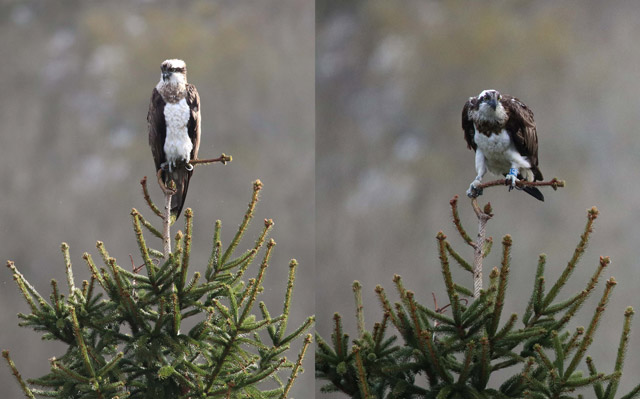 Adult female osprey - blue ring with white inscription JCO (born 2017). Image by Sarah Malcolm
Each bird travels alone, following its own route. As Morven is approaching seventeen, it is hard to know how many more journeys she will undertake. I hope that next year, one or both will be back to our little valley in North Devon. For now, their fleeting visit can be followed virtually through the sightings and reporting by others whose feet are grounded, but whose eyes remain on the skies.
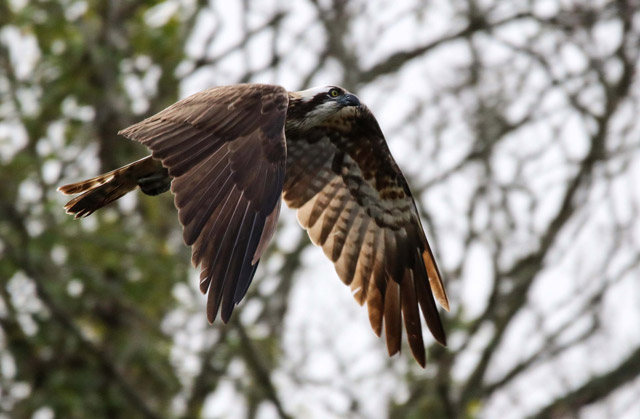 Adult female osprey - blue ring with white inscription JCO (born 2017). Image by Sarah Malcolm
Update: On Easter Friday, a farmer from Forres in Moray, Scotland, reported a pair of osprey on a long-used eyrie. The female, home to breed for yet another season, is Morven.