The Many Highlights of a Pantanal Wildlife Tour

When Wildlife Sales Consultant Helen Cox first visited Brazil, she was captivated by the country's wildlife and vowed to return. In May, she joined our popular Wildlife of the Pantanal group tour and this time around certainly didn't disappoint! Here she shares the highlights from the trip and why she wouldn't hesitate to go for a third time.
How is it possible to describe the wildlife experience in the Pantanal, I ask myself? It is simply a series of one highlight after the next, and sometimes highlights are exhilaratingly piled on top of each other!
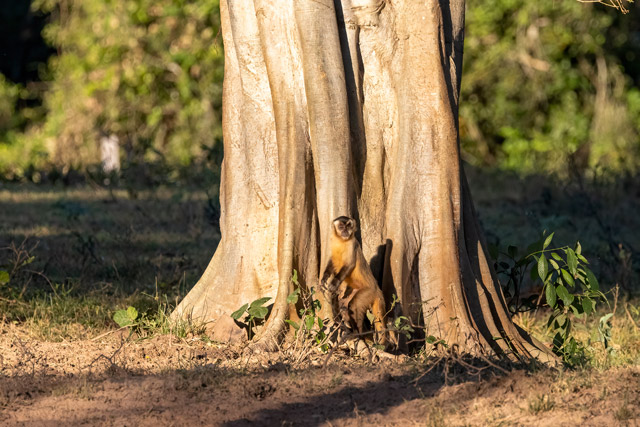
Whilst on a Wildlife of the Pantanal small group tour, travelling along the Transpantaneira road on our arrival day, it was quite a job to keep up with the species list – it was all action! On one occasion, we stopped to watch a mother yacaré caiman and her 43 babies as they crossed from one pool to another, whilst blue and yellow macaws squawked for attention overhead, followed by cattle egrets and monk parakeets. Azaras’ capuchin monkeys ran across the ground behind the caiman, with hyacinth macaws now doing fly-pasts close to us. Southern lapwings then joined the maelstrom, calling and posturing to warn the caiman procession away from their nest. While all this was going on, a couple of brightly coloured ameiva lizards basked lazily by the side of the road …
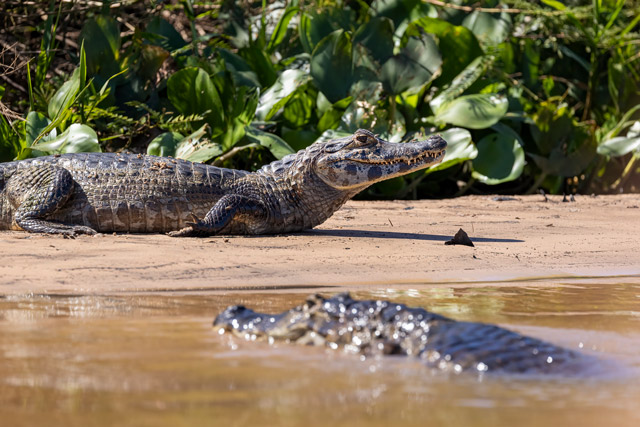
 The next morning, we rose just before dawn, when various bats were finishing their night shift and birds steadily awoke. The place was simply brimming with life, and we listened to the varied chorus of so many species as the sun rose, with the grating squawks of Chaco chachalacas contrasting with the deep booms of greater rheas, and all manner of other bird calls. Added to this were the wingbeats of herons, egrets and ducks as they flew overhead singularly, in pairs or much greater numbers, finding their favoured place in the wetland, ready for the day ahead. The water was alive with several yacaré caiman, including territorial males that displayed with a spectacular ‘dance’, arching their bodies, grunting and vibrating infrasonically so that water droplets sprung like miniature fountains in the air above them. Mesmerising!
 Speaking of sounds, on some mornings, we would wake to the susurration of black and gold howler monkeys calling in the distance, and we were fortunate to see many families when out on excursions. On one occasion, we stopped the boat’s engine and floated along, silently marvelling at a troupe which was calling loudly in nearby trees. On a forest walk, we were only a few metres away from the howlers, and you can just imagine what it’s like to be so close to creatures whose calls can be heard from almost five kilometres away!
 Seeing our first jaguar was incredible. We were only 40 minutes into our first boat transfer when our guide spotted him on the riverbank. It took me a while to get my eye in as I was instinctively looking for something half its size – he was HUGE! – and so well-camouflaged, absolutely still in hunting pose. He then walked along the river bank, where we followed, until we heard growling in the bushes ahead. Unbelievably, it was two more jaguars – fighting! This pair were concealed from view apart from the dramatic rustling of foliage, and we were primed for the first jaguar to join in. What then?! Sensibly, but sensationally for us, the first jaguar decided to avoid the risk of a squabble and swam across the river towards us and over to the opposite bank.
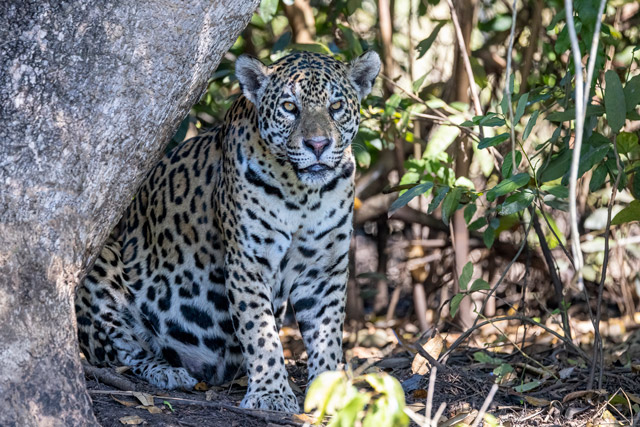
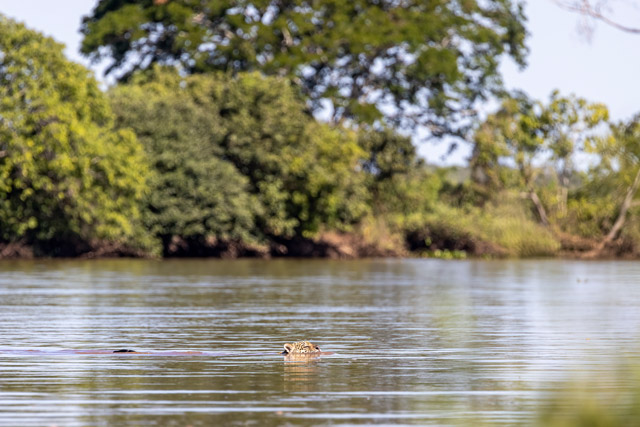 After that excitement, we continued our transfer but were soon delayed by a fourth jaguar! This was a female who posed for us beautifully, showing off her powerful jaws with enormous yawns. Needless to say, our transfer took rather longer than expected, but for good reason! Other jaguars included a mating pair, mother and daughter, and our final sighting was made as a jaguar swam into the viewfinders of our binoculars or cameras while we were focused on a boat-billed heron! We made a hasty retreat from our position, with our boat parked at the bank, as the sizeable big cat came ashore and approached to continue its journey!
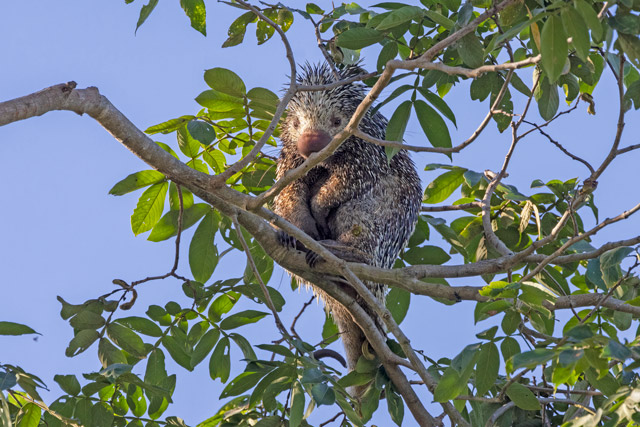
 One of the more unexpected sightings was a lovely view of Brazilian porcupines. They have a distinctive odour, which our guide and boat driver used to spot them. Arboreal and undeniably adorable, three of these spiny mammals with beady eyes and bulbous red noses were snoozing on the branches of trees by the river, sometimes waking for a lazy scratch using long-clawed paws.
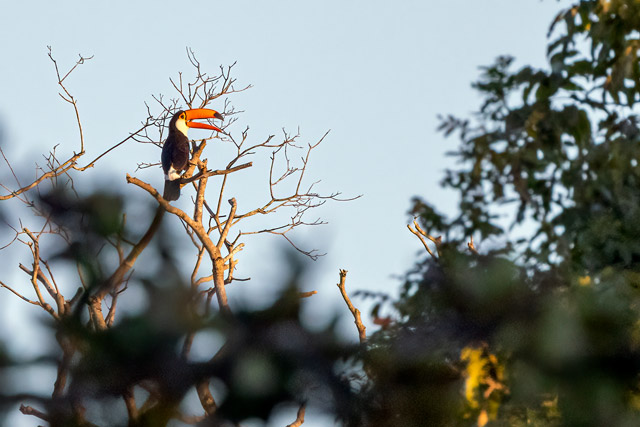
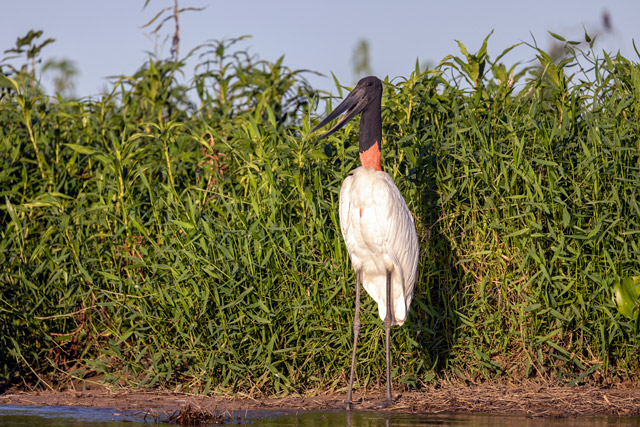
 The birdlife was fantastically diverse, and often very colourful, from small birds such as saffron finches, orange-backed troupials, yellow-billed and crested cardinals and vermilion flycatchers, to the medium-sized parakeets, amazons and toucans, to the large macaws and enormous jabiru storks with their bulbous red throats.
 One of my favourite birds that we came across was a capped heron, which is a really odd-looking bird with white wings, lemon-yellow breast, blue around the black eye, and blue bill ending in pink and purple. Its head was topped with a neat black crown, and extraordinary long plumes flowed backwards from its nape.
 Jabiru storks were grand, towering figures when standing at up to 140 centimetres tall, and almost seemed like light aircraft when they flew (perhaps a slight exaggeration - but with a wingspan of almost three metres, they were pretty impressive!). The opportunity to spend quality time with a pair at their nest whilst observing from a nearby tower was very special indeed. They worked together in the heat of the day, one shading their eggs and titivating the nest while the other fetched nesting material and water to pour over the other from their beak, keeping their partner and the nest cool. It was certainly fascinating behaviour to witness!
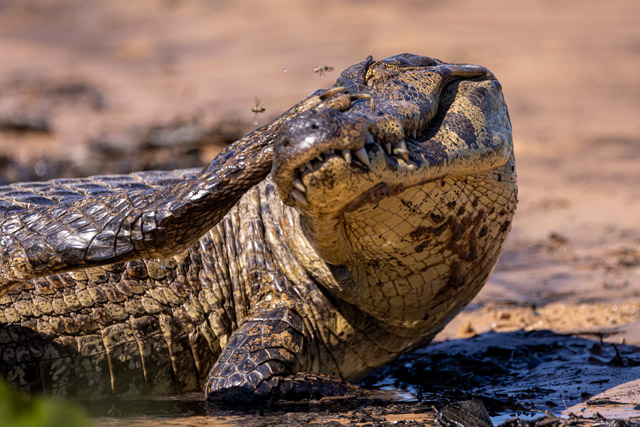
 We had some excellent talks by a naturalist at one of our lodges, including one about the abundant yacaré caiman found in the Pantanal, and how their skin is full of nerve endings, making them exceedingly sensitive. Armed with this information, we watched these tough-looking carnivores with more empathy as they were tickled by the flies that landed on their noses!
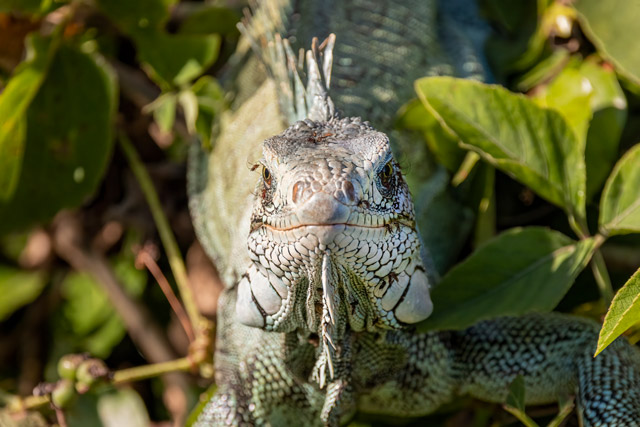
 Although caiman seemed the most abundant reptiles, along with green iguanas and tegu lizards, we also managed to see some snakes, including a central sipo vine snake hunting amongst the water hyacinths, another much larger snake that swam across the river so fast it was hard to identify, and an enormous caninana (tiger rat snake). The latter was very smartly patterned with black and yellow markings and well over two metres long!
 As the sunset faded and darkness fell in the evening on our boat rides back to our riverside lodge, nighthawks emerged and flitted beside and above us, whilst bats foraged closer to the water level. As the stars came out and the fireflies twinkled in the bushes, it was a magical conclusion to each day’s wildlife watching.
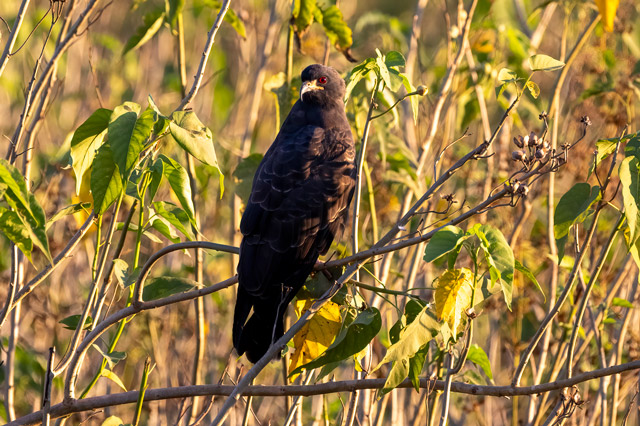
The grand finale on our last morning in Brazil was the spectacle of hundreds if not thousands of snail kites and egrets bursting aloft from their riverside roost at dawn, followed by a tapir swimming across beside our boat and crashing off into the bushes.
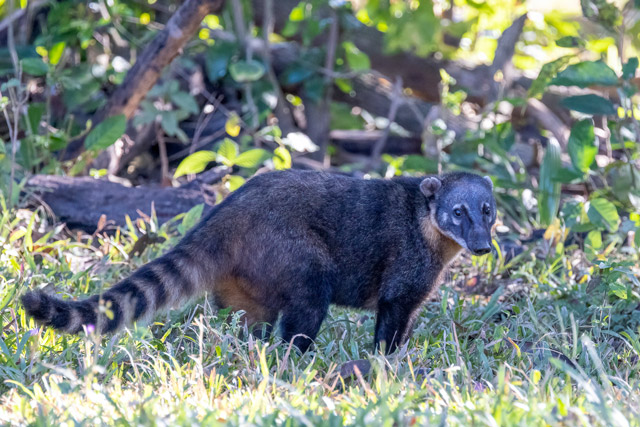
 I could go on (and on, and on), but other highlights included a diminutive ferruginous pygmy owl with a big heart as he called at us with puffed out chin feathers, contrasting with an enormous great horned owl being bothered by purplish jays and toco toucans; ocelots on my trail camera, one of which came right up and sniffed the lens; coatis snuffling about in the grounds one of our lodges; finally seeing a giant river otter swim right by the lodge after many days of searching (they were being unusually elusive); kingfishers – everywhere!; glimpsing lesser tamandua and giant anteater on night drives; enjoying the comical antics of hyacinth macaws; being stared at by a common gray four-eyed opossum; seeing a magnificent male marsh deer with its large antlers, and pretty red brocket deer, together with small mammals such as Azaras agouti, Brazilian guinea pig and some last-minute silvery marmosets in Cuiabá before we jetted away.
 The Pantanal – a place that has so much fauna to see that it’s hard to rest! What a wonderful problem to have, and how heartening to know that the Earth still holds such a precious place of great wildlife abundance. This was my second time and I would very much love to go again. If you haven’t been – it’s a must! And if all the above wasn't enough to tempt you, I've compiled the footage from my trail camera to show what else you can expect on this brilliant Pantanal wildlife tour.
Contact us today to find out more about our Wildlife of the Pantanal holiday.